
These Heroic Dogs Worked Through Blood, Debris and Exhaustion to Find Victims at Ground Zero
Guest Contributor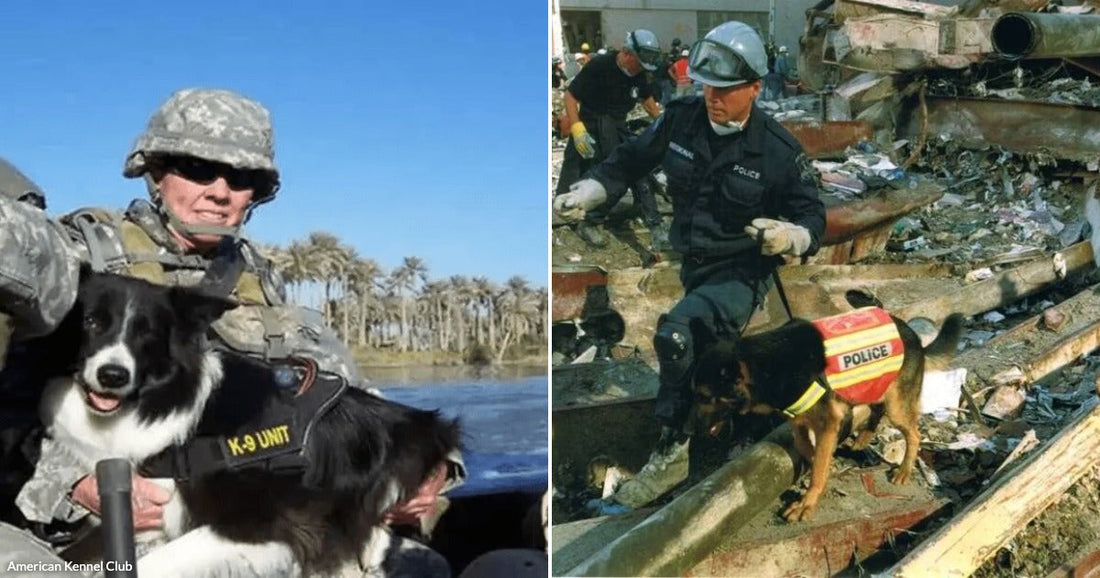
In the days after the attacks of September 11, 2001, the world watched exhausted firefighters, police officers, and volunteers pick through the wreckage of the World Trade Center and the Pentagon. Alongside them moved quieter figures whose presence was no less vital. These were the 9/11 rescue dogs, highly trained search and rescue canines who worked through smoke, dust, and twisted metal to look for survivors and bring some measure of comfort to those overwhelmed by loss. Their stories, from Riley the golden retriever to Apollo the German Shepherd, reveal a form of heroism that is both practical and deeply emotional, and they show why search and rescue dogs at Ground Zero remain an enduring symbol of courage.
These dogs were not simply symbolic. They played a major operational role in the search and rescue effort. In those first hours and days, when the hope of finding people alive in the rubble still burned bright, handlers and their canine partners navigated unstable debris fields, jagged metal, and toxic dust. One of the most powerful details from the record of that time is that the last living person to be rescued from the World Trade Center, found 27 hours after the collapse, was located with the help of a search dog. In a landscape that defied human senses, these animals extended the reach of human effort and kept the possibility of rescue alive.

The work was intense and relentless. Many 9/11 rescue dogs had been trained to locate living people in disaster zones, so their search patterns and mental focus were honed toward one clear goal. Yet the conditions at Ground Zero and the Pentagon were unlike most training scenarios. There were vast fields of rubble, deep voids, and hazardous materials everywhere. As the hours passed and successful finds became rarer, the psychological burden of the operation did not fall on humans alone. Handlers observed that the dogs themselves appeared to struggle when they could not locate survivors. The very instincts that made them excellent in training also made them sensitive to repeated searches that ended with nothing found.
To protect the welfare of their canine partners, handlers and trainers took a remarkably humane approach. They staged “mock finds,” deliberately creating scenarios where dogs could discover a hidden person or object and receive praise. This was not only a training tactic, it was a way to support canine morale during an operation that offered few natural rewards. The people on site understood that the emotional state of the animals affected their performance. They knew that reinforcing their sense of purpose helped them keep going in impossible conditions. I found this detail striking, because it highlights a mutual care and respect that often goes unrecognized in discussions of disaster response.

American Kennel Club
The physical toll on the search dogs was constant and severe. Working day after day in pulverized concrete, glass, ash, and twisted steel meant that every step carried a risk of cuts, burns, or embedded debris. Their paw pads took a beating on the unstable ground, and the fine dust in the air irritated their eyes and sensitive noses. Teams at Ground Zero and the Pentagon responded by building systems of care around the dogs. Veterinarians were stationed at the site to monitor them, clean their eyes and noses, and check injured paws. Handlers regularly wiped down their coats and examined them for signs of strain or injury. These measures did not remove the danger, but they reflected a clear recognition that the dogs were not expendable tools. They were valued partners whose well-being mattered.
One of the most moving individual stories from Ground Zero is that of Bretagne, a golden retriever whose very first official assignment was the 9/11 response. Bretagne was only two years old when she arrived in New York with her handler, Denise Corliss. Corliss was an electrical engineer who had become deeply interested in the work of disaster search dogs. She learned that civilian volunteers could, if they devoted themselves to rigorous training, join federal emergency response teams with their canine partners. That commitment required long hours. Corliss described spending 20 to 30 hours a week on training alone while still maintaining her full-time job.

Texas Task Force 1
All of that preparation led to Bretagne and Corliss qualifying for Texas Task Force 1 in 2000. Just one year later, their skills were called upon in the most public and heartbreaking way imaginable. At Ground Zero, they worked 12-hour shifts for two weeks straight. The pair navigated tangled debris and towering piles of wreckage, searching for any sign of life. Bretagne’s performance in this environment was not only technical, it was also emotional. Those who observed her noted her keen awareness of human feelings and her instinct to respond when someone was in distress.
One episode in particular captures Bretagne’s character. As Corliss recounted, there was a moment when a firefighter stood nearby, clearly weighed down by what he had seen. Bretagne noticed him and broke away from her handler, despite commands to stay close. Corliss later described the moment as if Bretagne were “flipping [her] the paw” and making her own choice about what mattered most. The dog walked straight to the firefighter, lay down beside him, and rested her head on his lap. It was a quiet act, yet it embodied the unique gift that therapy and search and rescue dogs bring to disaster sites. They offer connection, comfort, and nonjudgmental presence at a time when words often fail.
By 2014, Bretagne was 15 years old and recognized as one of the last surviving search and rescue dogs who had responded to the 9/11 attacks. Her life after Ground Zero continued to reflect the bond between working dogs and their communities. When her health declined, she was given a dignified farewell in June 2016. Members of the Cy-Fair Fire Department and Texas Task Force 1 lined up to salute her as she walked into the veterinary clinic for the final time. That gesture of respect acknowledged not only her service at the World Trade Center but also the broader legacy of all the 9/11 rescue dogs who risked their lives and health in the search for survivors.
Today, the stories of Bretagne, Riley, Apollo, and many other search dogs from 9/11 continue to circulate in documentaries, photo essays, and commemorations. They remind people that heroism took many forms in those days. Some heroes carried hoses and radios, others sifted through rubble with bare hands, and some moved on four legs, guided by incredible senses and unwavering loyalty. Although they often receive less attention than their human counterparts, these dogs were a crucial part of the emergency response. They helped locate the living, search respectfully for the lost, and provide comfort in the midst of chaos. In remembering them, people honor a partnership between humans and animals that, at its best, is rooted in trust, care, and shared purpose. Read more at https://allthatsinteresting.com/9-11-dogs
