
Seventy-Eight Exploited Dogs Escaped A Fighting Operation Built Around Violence, Former Owner Sentenced To 10 Years
Guest Contributor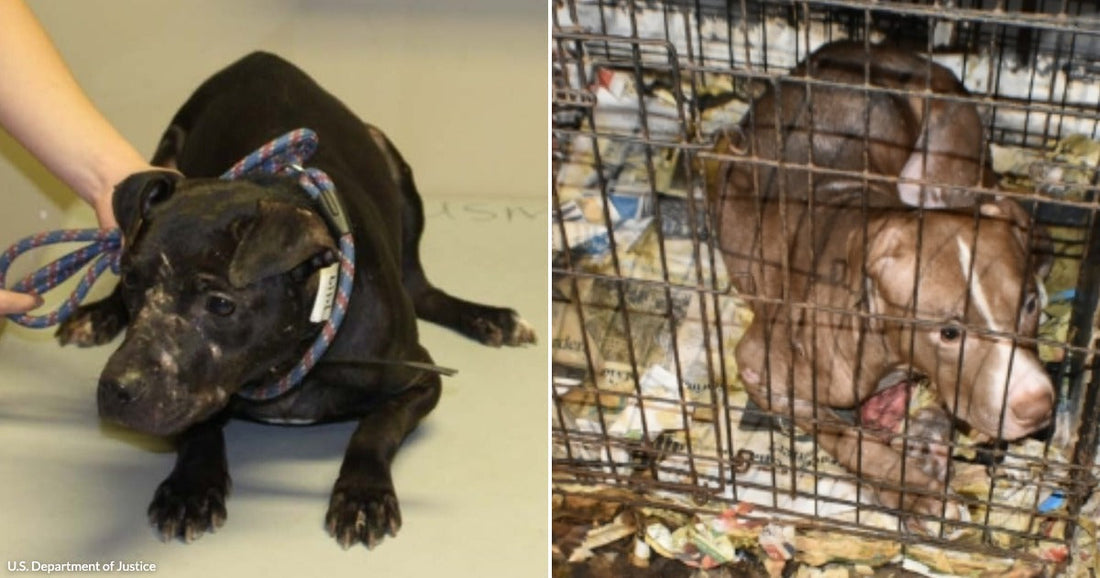
The recent sentencing of an Alabama man to 10 years in federal prison on dog fighting and firearms charges offers a stark look at the cruelty and criminality that often accompany organized dog fighting. This federal dog fighting case, which involved the rescue of 78 pit bull-type dogs and the seizure of a “Street Sweeper” shotgun classified as a destructive device, highlights both the suffering of the animals and the broader dangers to public safety.
According to court documents, Carlton Lenard Adams, of Bessemer and Adger, Alabama, maintained 78 dogs for fighting purposes across three properties. Some of the dogs bore scars and other injuries when authorities intervened. Others were found in conditions of extreme neglect. The scale of this case was striking: at the time the dogs were rescued, 78 dogs was the second-highest number saved from a single defendant in any federal dog fighting investigation.

U.S. Department of Justice
Adams pleaded guilty in January to four counts of possessing dogs for fighting purposes and two counts of possessing firearms after a prior felony conviction. Last month, a court sentenced him to 120 months in prison for these federal dog fighting and firearms charges. The court also ordered him to pay $548,449 in restitution to cover the costs of caring for the 78 rescued dogs. That financial penalty reflects the extensive veterinary treatment, housing, evaluation, and rehabilitation that animal victims of cruelty often require.
Federal officials involved in the case emphasized that dog fighting is not just about what happens in a ring. Principal Deputy Assistant Attorney General Adam Gustafson of the Justice Department’s Environment and Natural Resources Division stated that the cruelty stretches across the dogs’ entire lives. In his view, these animals suffer before, during, and after the fights, and addressing dog fighting is part of fulfilling Congress’s mandate to eliminate this illegal industry. The language he used underscores that dog fighting is not a series of isolated “matches” but a system of continuous exploitation.

U.S. Department of Justice
U.S. Attorney Phillip W. Williams Jr. for the Northern District of Alabama described Adams as a prior convicted violent felon and said he is now off the streets. Williams highlighted that the Department of Justice has made crimes against animals a priority, referencing a “whole-of-government” approach to enforcement. He also made clear that his office intends to show no mercy to individuals in the district who torture animals for entertainment. Those comments speak to the growing recognition in the justice system that animal cruelty is a serious crime that deserves significant attention and resources.
The investigation also revealed how closely animal fighting can intersect with other forms of crime and violence. During the search of Adams’s properties, law enforcement recovered two pistols and a semi-automatic shotgun known as a “Street Sweeper.” Under federal law, that type of shotgun is classified as a destructive device. The presence of such a weapon bolstered the government’s concern that dog fighting operations can be tied to dangerous weapons and heightened risks to the community.
John Walk, Inspector General for the U.S. Department of Agriculture, noted that the case reflects the brutal reality of organized dog fighting operations and the appalling conditions the animals are forced to endure. He also emphasized that dog fighting operations are frequently linked to broader criminal activity, as this case illustrates. Walk credited cooperation among federal, state, and local partners such as USDA’s Office of Inspector General, the FBI, and the Alabama Law Enforcement Agency, which jointly investigated the case.
When authorities searched Adams’s residences, they not only found animals and firearms, but also an array of equipment associated with training and maintaining dogs for fighting. The items included modified treadmills designed to hold dogs in place for conditioning, injectable veterinary steroids, suture materials, syringes, and skin staplers. Investigators also reported finding intravenous bags and lines, a homemade breeding stand, and a “break stick” device used to pry open a dog’s jaws during a fight. I found this detail striking because it shows a deliberate infrastructure for sustaining a system of cruelty, rather than isolated or impulsive acts.
After their rescue, the 78 dogs were placed in a care program administered by the U.S. Marshals Service. Their legal status was addressed through a separate civil forfeiture case brought by the U.S. Attorney’s Office for the Northern District of Alabama. Former Assistant U.S. Attorney Austin Shutt handled that civil proceeding, which was successful. The outcome meant that the dogs did not have to be returned to Adams, an important step for any long-term animal welfare plan.
Once the forfeiture was resolved, the animals could move forward toward more stable futures. They were rehabilitated and evaluated for possible adoption, a process that often involves behavioral assessments, medical treatment, and gradual introduction to new environments. Although the press material does not detail individual stories, the broad outline suggests that significant resources were devoted to giving these dogs a chance at safe, nonviolent lives. The cost of care, reflected in the substantial restitution order, points to the intensive effort required to address the harm inflicted by organized dog fighting.
Under federal law, dog fighting is illegal in a variety of ways. It is a crime not only to participate directly in fights that affect interstate commerce, but also to possess, train, transport, deliver, sell, purchase, or receive dogs for fighting purposes. This broad framework aims to disrupt the entire dog fighting enterprise, from breeding and training to the actual staging of fights. The Adams case illustrates how authorities can use that framework to address both the criminal conduct and the welfare of the animals involved.
Cases like this one also highlight a broader trend. As law enforcement agencies and prosecutors dedicate more resources to animal fighting investigations, they increasingly uncover arsenals of weapons, tools designed for cruelty, and networks of individuals engaging in multiple forms of crime. By treating animal fighting as a serious offense, authorities not only protect vulnerable animals, but also confront threats to community safety tied to illegal weapons and violence.
Senior Trial Attorney Ethan Eddy of the Environmental Crimes Section of ENRD and Assistant U.S. Attorney Ryan Rummage prosecuted the criminal case against Adams. Their work, together with the civil forfeiture effort and the coordination among multiple investigative agencies, demonstrates how federal, state, and local partners can work together on complex animal cruelty and public safety matters.
In the end, this case stands as a reminder that dog fighting is far more than an “animal issue.” It is a criminal enterprise with real consequences for animals, neighborhoods, and the rule of law. The 10-year sentence, the large restitution amount, and the coordinated response from various agencies send a clear message that organized dog fighting operations and related firearms offenses will face strong federal enforcement. Read more at https://www.justice.gov/opa/pr/alabama-man-sentenced-10-years-prison-federal-dog-fighting-and-firearms-charges-78-dogs