
💜 Thanksgiving Food Drive for Shelter Pets Help Us Feed 1 Million Shelter Pets!
A Barred Owl Rode in a Car's Front Grille in North Carolina and Survived
Guest Contributor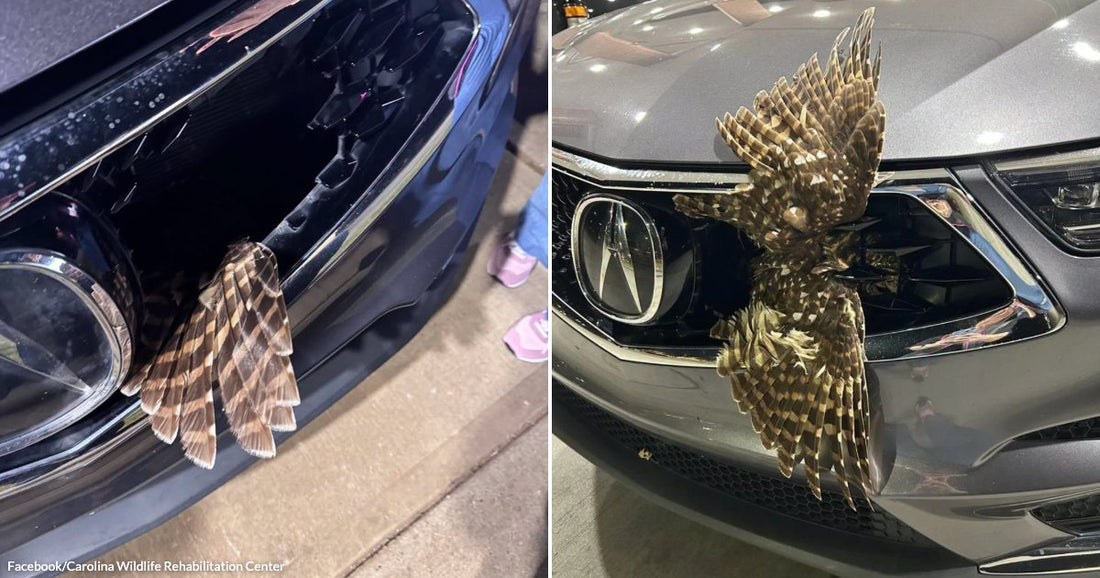
A routine drive in North Carolina turned into an unexpected rescue story when a barred owl became stuck in the front grille of a vehicle and survived. According to reports from the Carolina Wildlife Rehabilitation Center and the Concord Fire Department, the bird not only made it through the frightening impact but is also expected to make a full recovery. As wildlife stories go, this one is both tense and quietly uplifting, and it highlights how human beings sometimes become unlikely first responders to the natural world. For anyone interested in animal rescue, wildlife rehabilitation, or simply a hopeful story involving a rescued owl, this incident offers a memorable glimpse into the fragile connection between people and wild creatures.
The story began when a driver in North Carolina accidentally struck a barred owl on the road. Instead of the bird falling to the ground or flying off, the force of the collision caused it to become lodged in the vehicle’s front grille. Recognizing the seriousness of the situation, the driver went directly to the Concord Fire Department for help. That simple decision set in motion a careful and coordinated effort to free the trapped bird as safely as possible.

Facebook/Carolina Wildlife Rehabilitation Center
Firefighters stepped in to assist, approaching the vehicle and the owl with caution. A bird of prey caught in metal framing is a delicate problem. The rescuers had to protect themselves from the owl’s sharp beak and talons while also avoiding further injury to the animal. The account shared by the Carolina Wildlife Rehabilitation Center suggests that the responders managed that balance effectively, working gently to remove the owl from the grille. What could have been a tragic roadside accident instead became a successful on-site rescue.
Once freed, the owl was taken to the Carolina Wildlife Rehabilitation Center for assessment and care. Staff at the center shared on social media that the bird, identified as a barred owl, had survived the incident more intact than anyone might expect. They reported that the owl did not suffer any broken bones despite the impact and the time spent trapped in the car’s front end. That detail alone underscores both the owl’s resilience and the good fortune involved in this particular rescue.

Facebook/Carolina Wildlife Rehabilitation Center
There was, however, clear evidence of head trauma. The center explained that even in the absence of fractures, an impact with a moving vehicle can leave a bird dazed, disoriented, or suffering from more subtle internal injuries. Head trauma in owls and other raptors can affect balance, vision, coordination, and hunting ability, all of which are critical to survival in the wild. The staff made it clear that the owl would require time, rest, and close monitoring before any decision could be made about releasing her back into her natural habitat.
Rehabilitation specialists planned a recovery period that included rest in a safe enclosure, veterinary examinations, and ongoing observation. During that time, they would watch for improvements in the owl’s alertness, behavior, and physical responses. For a barred owl that has experienced such a direct impact with a vehicle, the goal is not merely survival in captivity. It is the restoration of full strength and function so the bird can safely return to the wild. The center noted that, with this care plan, the owl was expected to make a full recovery after a few weeks.
This kind of vehicle and wildlife collision is not rare. Across many regions, owls and other birds often hunt near roadways where artificial lighting attracts prey or where open stretches of pavement create clear hunting grounds. When a bird swoops low in pursuit of a small animal, it may misjudge the speed or distance of an oncoming car. In many cases, such collisions are fatal. That context makes this particular rescued owl story stand out because it ended with survival and a positive prognosis instead of loss.
The role of local fire departments and wildlife centers is also worth noting. The Concord Fire Department did not treat the trapped owl as a minor inconvenience or a simple removal task. Instead, firefighters took the situation seriously and facilitated a safe handoff to professionals trained in wildlife rehabilitation. The Carolina Wildlife Rehabilitation Center, in turn, demonstrated how specialized organizations can step in once the immediate crisis has passed, providing medical evaluation and longer term care.
For the driver, the decision to seek help rather than continue driving or attempt a risky self rescue reflected a sense of responsibility to the animal. While the original account does not dwell on the driver’s thoughts, the action itself points to compassion in the moment. Rather than viewing the owl as an unfortunate casualty, the driver saw an injured animal still alive and took steps to ensure it had a chance to recover.
I found this detail striking because it illustrates how small, individual choices can intersect with the work of trained responders and wildlife experts. No single person in this chain could have guaranteed the owl’s outcome alone. The driver alerted authorities, firefighters carefully extracted the bird, and rehabilitation staff committed to weeks of care. Together, those actions created a path from a roadside collision to an expected full recovery.
The story also gently reminds readers that wild animals, even resilient species like barred owls, remain vulnerable to human activity. Cars, roads, and expanding development introduce hazards that animals have not evolved to recognize. At the same time, humans now have institutions, knowledge, and tools that can help when accidents occur. When a motorist chooses to contact a fire department or wildlife center, that person draws on a kind of informal community safety net that includes both people and animals.
As the Carolina Wildlife Rehabilitation Center reported, the owl will stay under observation for several weeks and receive veterinary care tailored to her condition. Only when she demonstrates normal behavior, stable health, and the ability to function independently will she be released back into the wild. That final step will close the circle of this rescue narrative. A bird that collided with a vehicle, became stuck in a grille, and suffered head trauma will once again fly free in the North Carolina landscape.
Stories like this often spread quickly online, and it is easy to see why. They combine tension, relief, and a sense of quiet hope. In this case, a barred owl survived a scenario that often ends very differently, thanks to a driver who sought help, firefighters who responded with care, and a rehabilitation team dedicated to wildlife recovery. It is a reminder that even routine drives and everyday public services can, under the right circumstances, become part of a life saving effort for an animal that would otherwise have had little chance. Read more at https://www.yahoo.com