
Cat With Broken Bones Escapes A Brutal Past And Finally Finds The Gentle Home He Deserved
Guest Contributor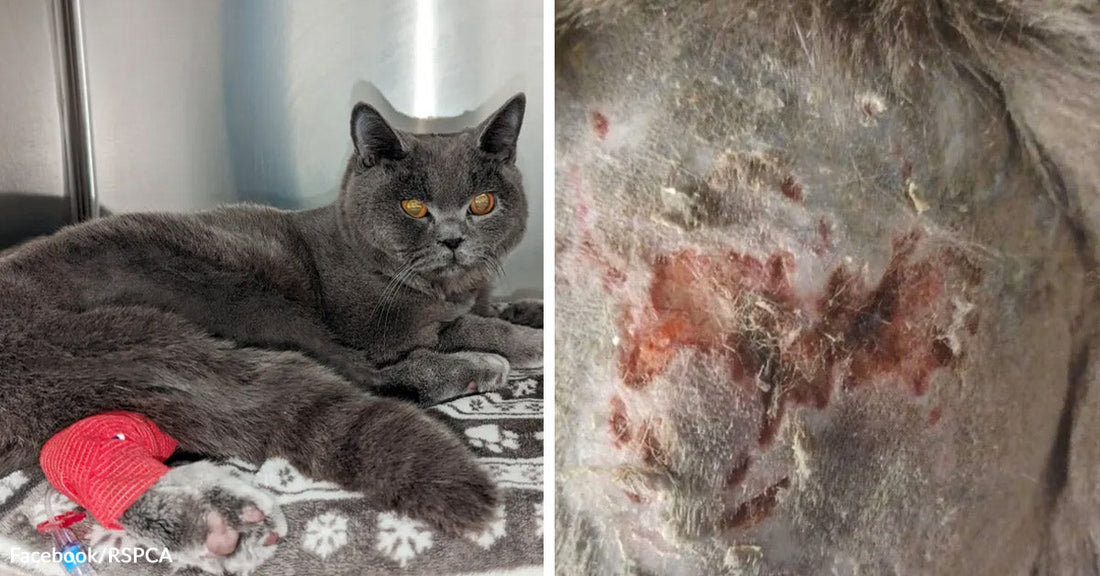
The story of a British Blue cat named Benito begins in pain and suspicion and ends in cautious hope. It is a vivid reminder of why animal cruelty laws matter, how trauma shapes behavior, and how patient care can help even the most frightened animals begin to trust again. Benito’s journey from repeated injuries and suspected abuse to a loving home is not only heartbreaking but also deeply inspiring for anyone who cares about animal welfare and cat adoption stories.
During the first year of his life, Benito experienced a disturbing series of severe injuries while living with a former owner. Between March and September 2023, veterinarians documented a pattern that was impossible to ignore. On different occasions they treated him for a fractured right femur, a broken leg, an injured pelvic limb, a limp tail, a chest injury, and hind leg limping. Each injury occurred separately, not as part of a single accident, which made the veterinary team increasingly concerned about what was really happening behind closed doors.

In November 2023 things became critical. Benito’s owner brought him back to the vet when he became weak, was meowing while walking, and could hardly stand. He showed a head tremor, was knuckling on all four limbs, and his usually feline alertness was replaced by an unusually subdued state. Further examination revealed something even more devastating: Benito had a fractured spine. At this point, the pattern of trauma was too stark to dismiss as coincidence or clumsiness.
The veterinary professionals involved decided it was time to escalate their concerns. Their suspicions that the injuries were not accidental led them to contact the Royal Society for the Prevention of Cruelty to Animals, the United Kingdom’s largest animal welfare charity. The RSPCA launched an investigation into Benito’s case, treating it as a potential example of severe animal cruelty rather than a string of unfortunate mishaps. Inspector Vicki Taylor later described Benito’s history as saddening, noting not only the long list of injuries but also a photograph that showed a burn he had suffered. In her view, the evidence suggested Benito was being hurt regularly by the person who should have been protecting him.
This case sits within a wider legal context that has been evolving in the United Kingdom. Under the Animal Welfare (Sentencing) Act, courts now have the authority to impose tougher penalties for serious cruelty offenses. Since June 2021 the maximum prison sentence for the worst forms of animal cruelty has increased from six months to five years, with the possibility of unlimited fines. The law is designed to address extreme offenses such as dog fighting, severe neglect, puppy abuse, and ear cropping. Benito’s story illustrates the kind of suffering that such legislation is meant to take seriously.
By contrast, animal cruelty laws in the United States remain less consistent from state to state. As of 2024 only 22 states require courts to impose bans on animal possession after a cruelty conviction, and even then the bans are often limited to specific crimes or certain species. Another 20 states, along with Guam and Washington, D.C., allow possession bans but leave them to the court’s discretion. Those differences highlight how uneven protections can be for animals depending on where they live, and why enforcement tools such as possession bans can be critical for preventing repeat abuse.
Once Benito was removed from his home, the extent of his injuries became even more apparent. When he first entered the care of the RSPCA, he was unable to stand and appeared hand shy whenever anyone reached toward his face. This kind of flinching response is often associated with animals who have learned to expect that human hands might hurt them rather than help them. Staff at the RSPCA’s Newbrook Animal Hospital in Birmingham, England, began immediate treatment for his spinal fracture and worked to stabilize his condition.
His recovery was intensive. For a month, Benito received pain relief every eight hours, along with antibiotics and structured physiotherapy. Because he could not move properly, staff turned him every six hours to avoid pressure-related problems, assisted him with toileting, and fed him while he lay on his chest so that he would not experience additional pain. It was a level of hands-on care that required both time and compassion. Over weeks, the focus was not only on healing his body but also on providing a predictable, gentle environment that could slowly rebuild a sense of safety.
After six weeks of cage rest combined with careful physiotherapy, signs of improvement began to appear. Benito started to regain strength and mobility. Once he was stable enough, he moved into foster care, which is often a vital bridge between medical treatment and permanent adoption. There he could experience a home setting again, this time one centered on patience and calm instead of fear.
Eventually Benito was adopted by 54-year-old Sugra Sabri and her daughter Razeenah. They prepared a separate room for him, following advice intended to help a shy or traumatized cat adjust gradually. Yet Benito’s initial reaction showed how deep his anxiety still ran. Instead of exploring the room, he bolted out with his tail curled in and hid in a corner. He ignored his food, stayed huddled in place, and avoided anyone coming near him. It took about a week before he began to edge into the kitchen, sniff around, and move cautiously toward his new caregivers.
One of the telling details of his early days in the home was his lack of interest in simple feline pleasures. Many cats are captivated by watching birds from a window, but Benito initially showed no curiosity. According to Sabri, it took around five months before he started to sit at the window and watch the world outside. That shift may seem small, yet for a cat emerging from trauma it signaled a growing willingness to engage with his surroundings and enjoy everyday experiences.
Today, Benito has the full run of the house and has revealed a gentle, affectionate personality shaped as much by his past as by his present. Sabri describes him as very loving and soft by nature. He does not scratch, and when he has had enough petting he simply moves away rather than reacting defensively. He is not a lap cat, which Sabri links to the fact that he did not have that kind of close, positive handling when he was young. Instead, he likes to sit near people rather than on them.
He has some endearing habits of his own. He likes someone to sit with him while he sleeps and seems to take comfort in simply having a trusted person nearby. When he wants affection, he will lie on the floor with his legs in the air, a posture that leaves his vulnerable underside exposed and indicates a measure of trust that would have been hard to imagine when he first arrived.
Sabri and her daughter formed a strong bond with him and decided that fostering was no longer enough. They chose to keep Benito permanently, calling him Benny. Any idea of returning him for another family to adopt did not feel right to them, given how sweet and gentle he had proven to be. Sabri’s daughter is particularly close to him. When Benito turned two, they celebrated with a joint birthday party for cat and human at her insistence, a small yet meaningful sign of how deeply he has become part of their family life.
Although Benito has physically healed, the shadows of his early experiences still appear in his behavior. He remains anxious at times, is easily startled by loud noises, avoids direct eye contact, and can be wary when new visitors arrive. Even so, his progress is significant. Where he once fled at the first sign of guests, he now often feels confident enough to lounge around while visitors are there. His family affectionately refers to him as a small cuddly bear because of his soft fur and gentle presence. Friends and guests have become fans as well, drawn to a cat whose quiet resilience speaks volumes.
Stories like Benito’s underline the importance of strong animal protection laws, vigilant veterinary professionals, and foster and adoptive families who are prepared to invest time in an animal’s emotional as well as physical recovery. They also remind us that healing from cruelty is rarely instant. It unfolds over months of small steps as an animal discovers that hands can offer comfort, that a home can be safe, and that trust can return in its own time. Read more at Newsweek