
No One Should Have to Choose Safety or Their Pet Help Build a Safe Place !
Blue the Conservation K-9 Helps Reinstate Wild Behavior at Grand Canyon
Guest Contributor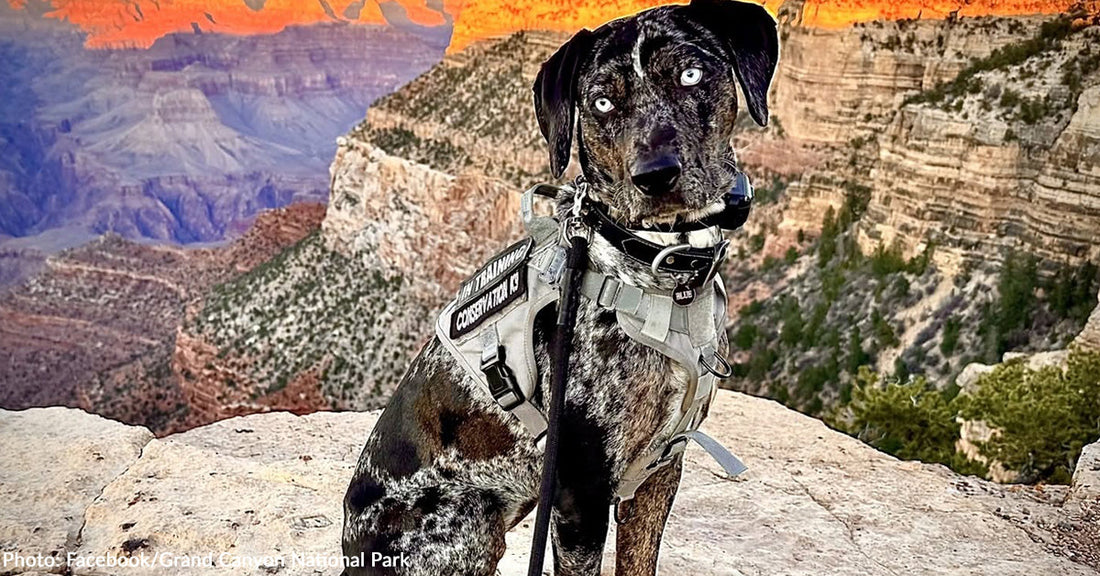
At Grand Canyon National Park, a new four-legged team member is helping address a growing challenge: habituated wildlife. Meet Blue, a certified Catahoula Leopard Hound and the star of a Conservation K-9 pilot project that uses a natural predator cue to guide elk and bighorn sheep away from busy developed areas. This conservation K-9 program blends science-based wildlife management with humane tactics to improve visitor safety and help wildlife stay wild.
Over the past several decades, park wildlife staff have documented a steady increase in elk and bighorn sheep using Grand Canyon Village and other highly visited parts of the South Rim as regular habitat. Some animals bed down near lodges, cross visitor paths, and linger close to roads and buildings. These spaces can look like safe havens for wildlife because predators such as cougars and coyotes tend to avoid densely developed and heavily trafficked areas.

For visitors, seeing a large elk or bighorn sheep up close can feel like a once in a lifetime moment. At the same time, these close encounters bring real safety risks. Habituated animals that lose their natural wariness of people are more likely to block traffic, stand their ground along roadsides, or approach crowds. During sensitive periods such as calving season or the late summer rut, the potential for aggressive behavior increases. In the most serious cases, wildlife managers can be forced to remove or euthanize individual animals that repeatedly endanger people.
To reduce the likelihood of those outcomes, Grand Canyon wildlife managers launched the Conservation K-9 Pilot Project with support from Grand Canyon Conservancy. The initiative is designed as a three year effort focused on long term behavioral change rather than short term fixes. Instead of relying solely on traditional hazing tools like staff on foot or paintball deterrents, the project brings in Blue to serve as a controlled, non-contact predator cue.
Blue’s role is grounded in her natural herding instincts. As a Catahoula Leopard Hound, she was selected for qualities such as endurance, trainability, and a calm temperament. Under the direction of her handler and project lead, wildlife biologist Brady Dunne, Blue uses controlled barking and herding pressure to encourage elk and bighorn sheep to move away from developed areas. She never bites or makes physical contact with wildlife and is always on a leash under direct control. Operations primarily focus on cow elk and female bighorn sheep, which tend to pose lower risk than bulls or rams.
Park staff have identified a set of “exclusion zones” where conflicts between wildlife and people have historically been most common. These zones include locations such as the El Tovar Complex, Grand Canyon Visitor Center, Maswik Lodge, the Mather Campground services area, and Grand Canyon School. Years of wildlife movement data, emergency response records, and visitor use patterns helped determine where Blue’s efforts could have the greatest impact.
When elk or bighorn sheep enter one of these exclusion zones, trained wildlife personnel may temporarily pause vehicle or foot traffic. That brief pause allows for a safe and focused hazing operation. Blue then applies her herding pressure through barking and movement, guiding animals away from the zone and back toward more natural habitat. As soon as the animals leave the targeted area, the operation ends and normal visitor activity resumes. This approach aims to reinforce boundaries without driving wildlife out of the park or eliminating opportunities for viewing them from a safe distance.
The Conservation K-9 effort is grounded in science as much as it is in fieldwork. Between 2018 and 2021, studies documented how elk were using developed areas on the South Rim as core habitat. Building on that research, wildlife staff deployed radio collars in fall 2025 on nine habituated elk and five habituated bighorn sheep. These collars help track how animals move through developed zones over time and how their behavior changes as the pilot project progresses.
Those new data are being compared with more than 15 years of existing wildlife monitoring and emergency callout records. The park plans to measure success through several clear indicators. These include reduced wildlife presence within exclusion zones, fewer emergency wildlife callouts, fewer hazardous human wildlife interactions, and observable changes in how elk and bighorn sheep use habitat in and around Grand Canyon Village. I found this long term approach particularly striking because it reflects a commitment not only to day to day safety but also to understanding how management decisions shape animal behavior across seasons and years.
Blue’s work is only one part of a broader strategy to address habituated wildlife. Grand Canyon staff continue to identify and reduce attractants that draw animals into developed spaces. Efforts include fixing water leaks, improving waste management so food scraps and trash do not become easy meals, and modifying landscaping that might otherwise provide appealing forage. By making high traffic areas less attractive to wildlife, managers can complement Blue’s hazing work with proactive prevention.
The project is also a community effort. Grand Canyon Conservancy provides most of the funding and partnership support for the Conservation K-9 program, reflecting strong interest in practical, humane wildlife management tools. Park staff emphasize that visitors share responsibility as well. People are asked not to approach, feed, haze, or attempt to move wildlife on their own. Human hazing can be dangerous, often fails to change animal behavior in a meaningful way, and may escalate risky situations rather than resolve them.
Visitors who notice elk or bighorn sheep lingering in parking lots, residential areas, or other developed parts of the park are encouraged to alert park staff or dispatch rather than intervene. That simple choice supports the structured, science-based system the park has put in place. It also reduces confusion for the animals. Consistent cues delivered by trained personnel and a conservation K-9 like Blue are more likely to promote the kind of healthy wariness that keeps wildlife farther from buildings and crowds.
Ultimately, the Conservation K-9 Pilot Project at Grand Canyon National Park aims to create a safer environment for both people and wildlife. By using a natural predator cue through a carefully trained dog, managers hope to guide elk and bighorn sheep back toward more natural patterns of movement and behavior. Instead of viewing developed areas as permanent safe zones, these animals can relearn to rely on the park’s vast wild landscapes. In a place as iconic and heavily visited as the Grand Canyon, Blue’s work illustrates how thoughtful, humane tools can support both unforgettable visitor experiences and the long term well-being of the animals that live there.
Read more at https://www.nps.gov/articles/000/conservation-k9-blue.htm