
Sea Turtle Bowtie Returns to the Ocean After Rescuers Remove Two Fishing Hooks From Her Neck and Throat
Guest Contributor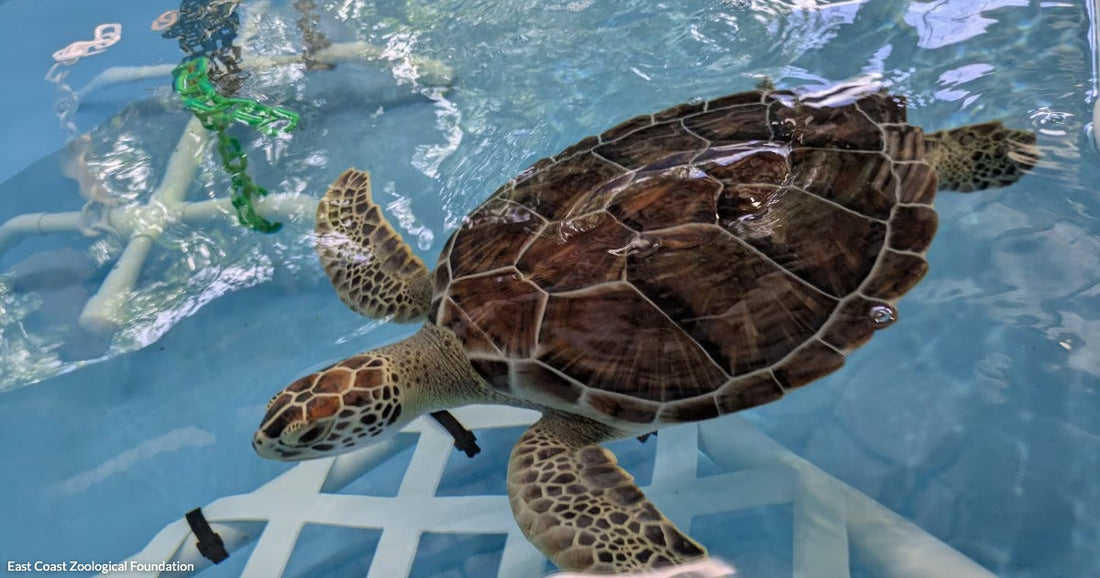
On a sunny Wednesday along Florida’s Space Coast, a young green sea turtle named Bowtie returned to the Atlantic Ocean at Lori Wilson Park in Cocoa Beach. The small crowd that gathered watched as staff from the East Coast Zoological Foundation’s Sea Turtle Rehabilitation Center at Brevard Zoo carefully carried the juvenile to the shoreline, then let the turtle navigate its own way into the surf. It was a simple moment, yet a powerful one, highlighting both the vulnerability of marine life and the quiet dedication of the people who work to protect it. For anyone who cares about ocean conservation or follows sea turtle rescue stories, Bowtie’s release offered a welcome piece of hopeful news.
Bowtie’s journey back to the sea began with an accident. In mid-August, a fisherman at Jetty Pier Park in Port Canaveral reported that a sea turtle had been accidentally hooked. The turtle was later identified as a juvenile green sea turtle, a species that spends its early years navigating coastal waters and seagrass beds. Responders brought Bowtie to the Sea Turtle Rehabilitation Center, where veterinarians quickly discovered that the situation was more serious than a simple surface injury.

Examination revealed a large hook lodged under Bowtie’s neck. Veterinary staff removed that hook, then used a video endoscope to investigate further. The scope allowed them to see inside the turtle’s esophagus, where they located a second hook that could not be seen from the outside. With careful technique, they removed that internal hook as well. It is a reminder of how what may look like a minor entanglement or injury at first glance can be more complicated beneath the surface, especially for marine animals that cannot communicate pain or discomfort.
Following these procedures, Bowtie’s recovery was notably swift. Under the care of the rehabilitation team, the turtle regained strength and normal behavior patterns, meeting the benchmarks that veterinarians use to decide whether a sea turtle is fit to return to the wild. Only after being cleared in good health did Bowtie make the trip from the rehabilitation center back to Cocoa Beach for release. Stories like this help illustrate how a well equipped sea turtle rehabilitation program can transform a single distress call into a successful conservation outcome.

East Coast Zoological Foundation
Moments like Bowtie’s release are heartening, yet they also underscore a persistent challenge: the overlap between popular fishing locations and sea turtle habitat. The foundation used this case as a chance to share practical guidance for anglers. They encouraged people who fish to remain especially watchful for sea turtles in the water near their lines and to avoid casting when turtles are in the immediate area. This small adjustment can significantly reduce the risk of accidentally hooking or entangling marine turtles, which often surface for air in the same waters where lines and lures are present.
Accidental hooking is only one of many hazards sea turtles face along developed coastlines, but it is one in which human choices can make a rapid difference. When fishers pause for a moment to scan the water or reel in lines as a turtle passes close by, they help prevent injuries like the ones Bowtie experienced. It can also reduce the stress and danger involved when a turtle has to be captured and transported for care. A bit of awareness can spare both animals and people a great deal of difficulty.
In the event that someone encounters a sea turtle that appears injured, entangled or otherwise in distress, responders stress that people should not attempt to handle the animal on their own. Sea turtles are protected wildlife and can be easily harmed by well intentioned but inexperienced efforts. Instead, the guidance is to observe the turtle from a safe distance and report the sighting to trained responders who have the expertise, equipment and legal authority to assist. That process is what enabled Bowtie to reach professional care quickly enough for a positive outcome.
The organization behind this rescue and release, the East Coast Zoological Foundation, plays a central role in regional marine conservation work. Based in Melbourne, the foundation operates both the Brevard Zoo and the Bowen Aquarium campuses. Founded in 1986, it has grown into a nonprofit institution that supports a variety of animal care, education and conservation programs. Importantly, the foundation does not receive recurring operating funds from city, county or state governments. Instead, it relies on private donations to maintain facilities such as the Sea Turtle Rehabilitation Center that cared for Bowtie.
I found this detail striking because it emphasizes how much wildlife rescue depends not only on science and skilled staff, but also on community support. Every successful sea turtle release reflects countless small contributions of time, expertise and funding. When organizations like this can invest in tools such as video endoscopes or specialized marine enclosures, they are better prepared to respond to emergencies that may arise without warning. Bowtie’s story, in this sense, is not only about one turtle but about the network of people and resources that stood ready when help was needed.
For coastal communities like those around Cocoa Beach and Port Canaveral, encounters with marine life are part of daily life and local identity. Seeing a juvenile sea turtle make its way back into the surf offers a tangible reminder of the rich ecosystems just offshore. It can also serve as a quiet prompt to consider how everyday activities relate to ocean health. Whether through responsible fishing practices, support for local conservation efforts or simple curiosity about the natural world, residents and visitors alike can play a role in safeguarding the waters these animals depend on.
Bowtie’s release into Cocoa Beach waters reflects a broader pattern of rescue, rehabilitation and return that is increasingly vital for marine species under pressure from human activity and environmental change. Each successful case adds to the collective knowledge of how best to treat specific injuries, manage rehabilitation and determine release readiness. Just as important, each one offers a story that helps connect people emotionally to conservation work that might otherwise seem distant or abstract. Watching a turtle disappear beneath the waves after a second chance at life can be a powerful reminder of what is at stake and what can be achieved when people respond with care.