
Raccoon Gets So Hopelessly Stuck Rescuers Carry Away the Entire Sewer Grate
Guest Contributor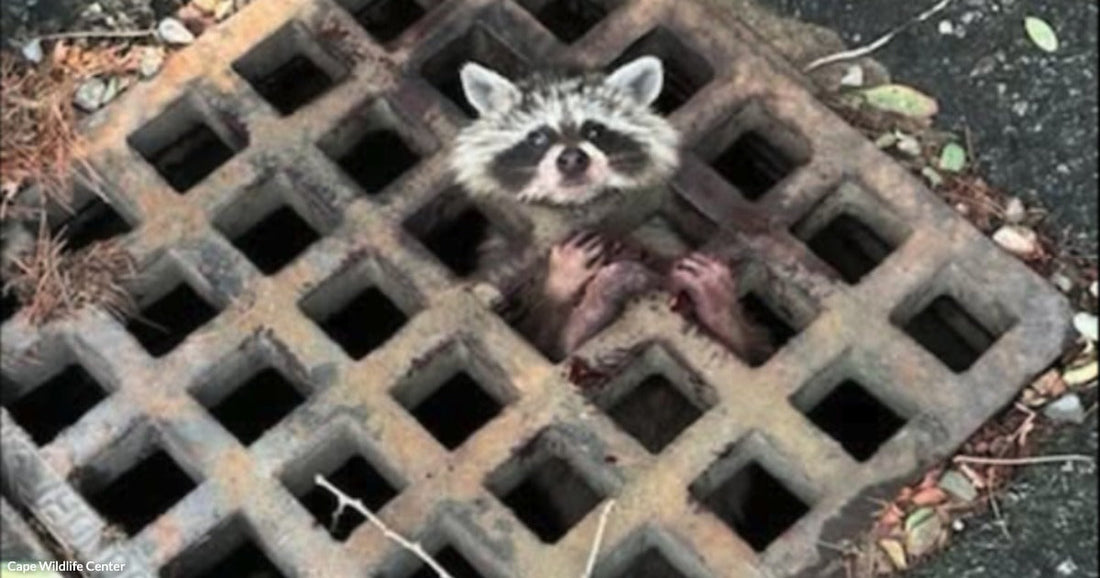
Everyday heroism often looks quieter than people expect. It can show up not as a dramatic movie scene, but as a group of local workers gathering around a storm drain to help a frightened animal in distress. That is exactly what happened in Bourne, Massachusetts, where emergency personnel joined forces to rescue a trapped raccoon and transport him, sewer grate and all, to Cape Wildlife Center. This collaborative raccoon rescue story is a gentle reminder of how compassion, expertise, and community spirit can come together in a very practical way.
According to Cape Wildlife Center, the young raccoon found himself in serious trouble when his head became wedged through the metal grate of a storm drain. Although the details of how he got stuck are not reported, the result was clear. He could not free himself, and leaving him there would have put him at significant risk of injury or worse. The situation called for both care and coordination, and local responders stepped in quickly.

What made this rescue unique was the solution the teams decided on. Rather than trying to extract the raccoon on the spot and risk hurting him further, responders chose to transport the entire sewer grate along with the animal still trapped in it. The Cape Wildlife Center explained that their veterinary staff were already handling other emergencies and could not come to the site to sedate the raccoon. Bringing the raccoon and the grate together to the facility was the safest choice that balanced animal welfare with practical limitations.
The collaboration itself was notable. The Bourne Department of Natural Resources, Fire Department, Police Department, and Department of Public Works all contributed to the effort. Each department brought its own skills and resources. Together, they were able to carefully remove the grate and move the raccoon safely to the wildlife center. In a statement shared on social media, Cape Wildlife Center acknowledged this teamwork, saying that in their line of work it sometimes takes a village to do what they do, and that this young raccoon had many people fighting to save him.

Cape Wildlife Center
The image of multiple municipal departments joining forces over a single distressed animal is striking. It illustrates a broader truth about wildlife rescues. These situations are rarely simple, and they often require more than one person or agency. Cape Wildlife Center highlighted this reality directly, noting that wildlife rescues do not always happen with one person or one team. In this case, the effort clearly belonged to an entire community of professionals responding to an animal in need.
Once the raccoon and the grate arrived at Cape Wildlife Center, the veterinary team took over. At that point, the challenge shifted from transport and logistics to medical care and safe extraction. Staff sedated the raccoon so they could work without causing him further fear or pain. Then they turned to an unassuming but very effective tool for this sort of problem. Using canola oil along with plastic garbage bags, they worked to reduce friction and ease his head back through the metal bars.
The center reported that the process was not entirely straightforward. It took a couple of attempts to find the right angle and amount of lubrication. Within roughly ten minutes of careful maneuvering, though, the team succeeded and freed the young raccoon from the grate. This detail underscores how even short rescues can require precision, patience, and creative use of everyday materials. The reliance on something as common as cooking oil, paired with proper sedation and professional oversight, shows how wildlife care personnel adapt to the situations they face.
After the raccoon was freed, the next concern was his condition. Cape Wildlife Center shared that once he regained consciousness, he was able to move all his limbs and his neck appropriately. That kind of neurological and physical check is crucial after an incident where an animal has been stuck and stressed. It helps determine whether there are lasting injuries or if the animal has a good chance at full recovery.
The center has placed him in an outdoor enclosure where staff can continue to monitor his recovery. This step reflects a standard approach in wildlife rehabilitation. Instead of releasing an animal immediately after a stressful rescue, professionals observe for delayed complications, changes in behavior, or signs of pain that might not appear right away. The goal is to ensure that when the raccoon returns to the wild, he has the best possible chance to resume normal behaviors.
Cape Wildlife Center expressed gratitude to everyone involved, emphasizing that this rescue truly took a whole community working together. The phrase is more than a figure of speech here. The raccoon’s outcome depended on coordinated efforts in the field, thoughtful decisions about transport, and skilled veterinary care. I found this detail striking because it shows public services and wildlife experts working side by side, not only for human safety but also for the well-being of local animals.
Stories like this highlight how local emergency responders often find themselves helping more than just people. Police officers, firefighters, public works crews, and natural resources staff can all be called into situations that involve native wildlife. That work may not always make headlines, yet it reflects a community’s broader commitment to coexistence with the animals that share its environment. When responders carefully remove a sewer grate, carry it to a clinic, and stand by while specialists take over, it represents a quiet kind of civic care.
The Bourne raccoon rescue also shows how modest tools can have a large impact when combined with expertise. The team’s use of sedation, canola oil, and plastic bags created a safe and low-tech way to solve what looked like a high-stress problem. Paired with vigilant post-rescue monitoring in an outdoor enclosure, the entire effort offers a clear example of modern wildlife rehabilitation practices in action. It is one small, hopeful story that reflects a larger pattern. Communities rely on their institutions, and those institutions often respond with compassion not only for residents, but for the wildlife that lives alongside them.