
Singing Dogs Astonish Researchers By Matching The Pitch Of Their Favorite Songs
Guest Contributor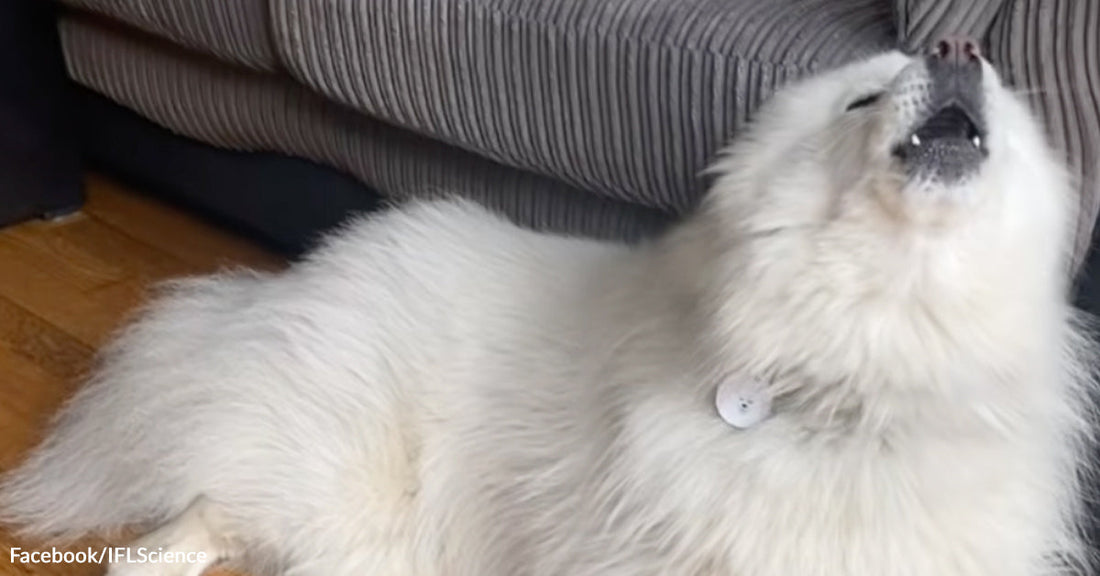
Most dog guardians have wondered at some point whether their pet’s mournful howl is anything like a wolf’s call to the pack. New research suggests that at least some dogs can do far more than simply produce a dramatic noise. A small group of Samoyeds and Shiba Inus have now demonstrated that they can sing on pitch and even adjust their howling to match their favorite songs. This glimpse into how dogs control their voices offers fresh insight into canine communication and the deep roots they share with wolves.
The study began with a simple question: can domesticated dogs regulate the pitch of their howls in a way that resembles their wild ancestors? Wolves are known to alter the pitch of their howls during group choruses, a behavior thought to make their pack sound larger and more formidable. The researchers wondered whether that flexible pitch control survived in certain dog breeds known to be closer to ancient lineages and still inclined to howl.

YouTube/IFLScience
To explore that question, the team turned to crowdsourcing. They specifically sought guardians of “ancient dog breeds” whose pets had a known habit of howling along to music or sirens. Instead of bringing the dogs into a lab, the study asked people to record their animals at home. The researchers supplied howl-inducing audio clips, then altered those clips by moving them up or down in pitch by three semitones. This allowed them to see whether the dogs would modify their own howls in response to shifts in the audio, a key test of pitch-matching ability.
Participants were asked to film their dogs howling along to three versions of the same sound. One version kept the original pitch, while the other two were shifted slightly higher or lower. Importantly, the animals were not forced to stay. The dogs could leave the room at any time during the recording, which helped keep the experiment as natural and stress free as possible.

YouTube/IFLScience
In the end, six dogs met the criteria for the study. Four were Samoyeds, a fluffy, vocal northern breed, and two were Shiba Inus, an ancient Japanese breed known for expressive vocalizations. The sample may have been small, yet these dogs provided clear and measurable data on howling behavior.
To understand exactly how the dogs responded, the researchers focused on three acoustic features of each howl. The first was duration, essentially how long the howl lasted. The second was mean frequency, which captured the average pitch across a howl. The third was the spectral centroid. This is a concept from digital signal processing that locates the “center of mass” of a sound and identifies where most of the signal’s power comes from. In more intuitive terms, it helps determine whether a sound is darker and lower or brighter and more energy rich at higher frequencies.
By analyzing all three measures together, the team could distinguish between dogs that simply howled louder or longer and dogs that genuinely adjusted pitch or the distribution of sound energy. The question was not only whether the animals would track the musical notes, but also whether they changed how their voice sounded in more subtle ways as the stimuli shifted up or down.
The results for the Samoyeds were particularly striking. Three of the four howled in response to popular songs that included human vocals. Their playlists covered a range of styles, from “Believer” by Imagine Dragons to the Oscar winning duet “Shallow” by Lady Gaga and Bradley Cooper and the dance track “Grapevine” by Tiësto. When the pitch of these songs was shifted by three semitones, those three Samoyeds altered the pitch of their own howls to follow the change. Their spectral centroid, however, stayed roughly the same, suggesting that while they tracked pitch, they did not significantly alter the overall brightness or timbral quality of their voices.
The fourth Samoyed, named Alfie, howled along to something very different, “Let the Bright Seraphim” by G. F. Handel. Alfie stood out from the group. Not only did he adjust his pitch as the recording moved higher or lower, he also changed his spectral centroid. That pattern indicates a more complex shift in vocal production, as if he were reshaping both the note he aimed for and the quality of the sound itself. I found this detail striking because it suggests that at least some dogs may have a surprisingly nuanced command over their howling.
The Shiba Inus behaved differently. Neither Shiba showed evidence of changing the pitch of their howls in response to the altered recordings. One of them, however, did increase its spectral centroid, hinting at a brighter, more high energy sound rather than a simple pitch shift. Across all six dogs, there was one constant. Neither the Samoyeds nor the Shibas changed the overall duration of their howls during the experiment. This stability in timing made it easier to see that the main adjustments took place in frequency related aspects of the sound.
From these observations, the authors concluded that some dogs possess flexible control of voice pitch that does not rely on the kind of advanced vocal learning associated with human speech or birdsong. In their words, the findings show that flexible control of voice pitch can evolve independently of complex vocal learning in mammals, especially in contexts where animals vocalize together. Humans can shift pitch to sing along with music even without formal training. The dogs in this study appear to share a version of that ability, at least within the specific circumstances tested.
This discovery also resonates with what is known about wolves. In the wild, wolves modulate the pitch of their howls when they chorus as a group. One hypothesis is that this creates the illusion of more individuals than are actually present or signals a stronger pack to nearby rivals. The fact that these relatively ancient dog breeds can still manipulate their howls in similar ways suggests that this vocal flexibility has deep evolutionary roots. Domestication has changed many aspects of dog behavior, but this research hints that certain foundational traits in vocal control have persisted.
Beyond its scientific value, the study offers a new way of looking at familiar behavior. A dog tilting its head back and “singing” along to a favorite song might be doing more than expressing excitement or anxiety. In some cases, that dog could be tracking the structure of the sound and aligning its own voice in a way that parallels human group singing and wolf choruses. While the sample size is small and focused on specific breeds, the work opens doors for larger studies that could test more kinds of dogs, different musical styles, and other contexts like sirens or natural sounds.
For anyone who lives with a vocal dog, these findings may add an extra layer of appreciation to those loud, dramatic howls. Underneath the noise, there could be a refined ability to match pitch and alter vocal quality that connects modern pets to their distant ancestors. At the very least, the research shows that canine “singalongs” can be more musically sophisticated than many might expect, and that the roots of group vocalization in mammals are still being uncovered note by note. Read more at IFLScience