
💜 Thanksgiving Food Drive for Shelter Pets Help Us Feed 1 Million Shelter Pets!
Beloved Hippo Fiona Dies After Swallowing A Hat That Accidentally Landed In Her Enclosure
Guest Contributor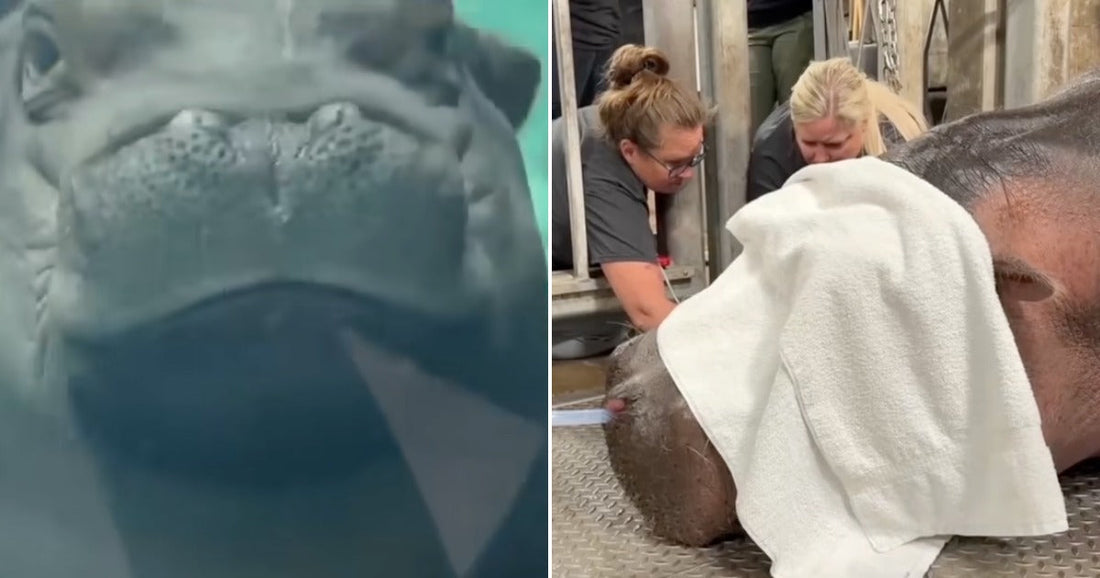
Cincinnati and animal lovers around the world are mourning Fiona the hippo, the Cincinnati Zoo’s beloved star, who died at just 9 years old after complications from eating a hat that entered her enclosure by accident. The heartbreaking news has stirred grief far beyond Ohio, a sign of just how deeply this charismatic hippo had become part of global culture and how seriously zoos take animal safety and visitor responsibility.
According to the Cincinnati Zoo, Fiona ingested a knit hat that wound up in her habitat last week. The item did not land in the water or get deliberately thrown at her. Zoo officials explained that a visitor tossed the hat into the air, where it was caught by a ceiling fan that then propelled it through a small opening above the viewing windows and into Fiona’s space. What sounds like a freak accident became a medical crisis for an animal known worldwide for her resilience and charm.

YouTube/WCPO 9
In its public statement, the zoo shared that its veterinary and keeper teams made multiple attempts to help Fiona pass the hat through her system. The staff tried different approaches, including having Fiona stand on a vibration plate with the hope that gentle shaking might stimulate her digestive tract and encourage the foreign object to move. Despite those efforts and what the zoo described as “necessary supportive care” on the final day, Fiona did not recover.
Experts say the problem began with the nature of the object itself. Hippos are primarily herbivores whose diets mostly consist of grass and other plant material. A knit hat made of synthetic fibers is not something a hippo’s digestive system is equipped to handle. Dr. Gabriella Flacke, an associate veterinarian at Zoo Miami who has experience with hippos, told NBC News that the hat was likely non-digestible from the start. She said it probably moved through Fiona’s intestines largely in its original form, which made it extremely difficult to pass.

YouTube/WCPO 9
Flacke explained that inside the gut, such material can soak up fluid from the intestinal tract and become more swollen and dense. In Fiona’s case the hat appears to have been simply too large to make its way through her intestines. It could not be broken down, yet it also could not fit through the narrow points of her digestive system. That physical impasse is believed to have led to the fatal complications, which will be studied further in a necropsy.
Similar incidents have been reported in other hippos. Flacke noted that there have been previous cases where hippos ate items they should not have and that many of those situations ended with the animals not surviving. On some rare occasions the objects were eventually passed in feces, but such outcomes are not guaranteed. Large, non-digestible items pose especially grave risks to big animals whose digestive anatomy is difficult to access safely.
Surgery, which might sound like an obvious solution to people used to companion animal medicine, was not a realistic option for Fiona. Flacke emphasized that abdominal surgery on a hippo is extraordinarily high-risk. Hippos are massive, and the pressure their bulk creates on the abdomen can stress any surgical incision, making it harder to heal. On top of that, hippo skin is very thick and structurally different from that of many other mammals, which complicates both the incision and the healing process. She explained that their skin simply does not heal in the same way that human, dog or horse skin typically does, which greatly reduces the chances of a successful recovery after an operation.
Fiona’s death has left her care team and the broader community deeply shaken. The zoo acknowledged that people in Cincinnati and far beyond would be “crushed” by the news, reflecting how widely she had been embraced. Staff members asked the public to keep Fiona’s caretakers in their thoughts as they process the loss of an animal many of them had known and nurtured since her first fragile days.
Fiona’s story captured the world’s attention from the moment she was born prematurely in January 2017, six weeks before her due date. Her survival was never guaranteed. People followed her progress online, rooting for a tiny hippo who seemed determined to defy the odds. As she grew, Fiona evolved from a fragile neonatal patient into a symbol of joy, perseverance and hope in Cincinnati. Books were written about her, she inspired a line of beer and even served as the backdrop for a marriage proposal at her exhibit.
City leaders recognized how deeply she had become part of Cincinnati’s identity. Mayor Aftab Pureval posted a tribute calling Fiona a “symbol of perseverance and joy” who brought smiles to faces of children, parents and visitors from around the globe. He wrote that the city was heartbroken but grateful that she had been part of its shared life. For many residents and fans, Fiona was not just an animal at a zoo but a local celebrity and a gentle mascot for resilience.
Flacke remembered Fiona as “such a charismatic animal” who had “a really rough start in life and then beat all the odds.” Those qualities likely explain why her death hits so hard. Her story had the narrative arc of a miracle survivor who overcame extraordinary challenges. To lose her to something so seemingly trivial as a misplaced hat feels particularly painful, underscoring how delicate life can be even for a powerful, two-ton hippo.
Her passing also highlights an important lesson for zoo visitors everywhere. Even items that seem harmless, like a knit hat, can become deadly when they enter an animal habitat. Modern zoos invest heavily in enclosure design, staff training and visitor education, yet a split-second misjudgment or a playful moment can still lead to unintended consequences. I found this detail striking because it shows how a small, unthinking action in a public space can have enormous ramifications for the animals we go there to admire and learn about.
As the Cincinnati Zoo prepares for a necropsy to better understand exactly what happened inside Fiona’s body, many people are reflecting on her legacy. She inspired affection, scientific curiosity and civic pride, and she helped countless children and adults feel more connected to wildlife. Her life also sparked public conversations about premature animal care, hippo health and the complex challenges of caring for large, wild species in human-managed environments.
In the wake of this loss, Fiona’s story may continue to influence how zoos design viewing spaces, manage potential hazards and communicate with visitors about their role in protecting animals. Her memory is likely to endure not only in books, photos and social media posts, but also in the quiet, behind-the-scenes changes that help prevent similar tragedies. For those who followed her journey from a fragile newborn to a global icon, Fiona will remain a reminder of both the hope that careful care can create and the responsibility that comes with sharing space, even briefly, with wild animals.