
Be A Hero & Support Those Who Served This Veterans Day Give Today!
Two German Shepherds Could Not Escape a Deep Canal Until Firefighters Climbed Down to Carry Them Out
Guest Contributor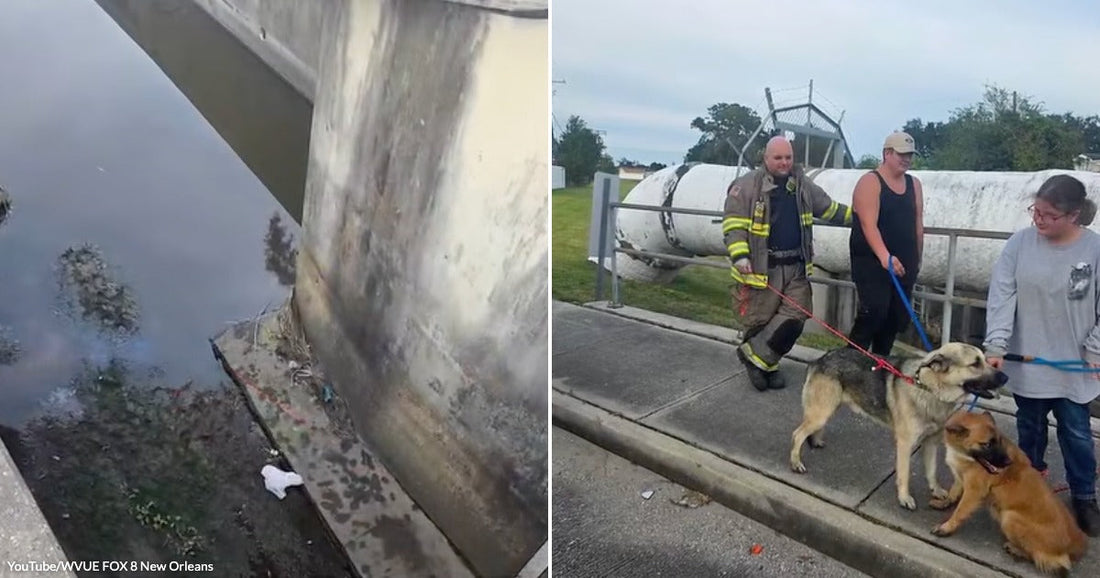
In Harvey, Louisiana, a routine Sunday afternoon turned into a quiet story of compassion and quick thinking, as firefighters rescued two German shepherds trapped in a drainage canal. Local officials say the Harvey Volunteer Fire Company Two received a call around 4 p.m. about the dogs in distress, and what followed became a small but meaningful reminder of the bond between people and animals. Stories like this often travel quickly online, and it is easy to see why. A simple phrase like “firefighters rescue 2 German shepherds” carries an immediate emotional pull, combining urgency with hope.
According to the report, the two German shepherds were stuck in a drainage canal that was too deep for them to climb out on their own. While no one on the scene knew how the dogs got into the canal, what mattered most in that moment was finding a safe way to bring them back to solid ground. The setting itself highlights a common urban challenge. Drainage canals are important for managing stormwater in communities like Harvey, yet they can become dangerous traps for animals and, at times, people. In this case, the dogs were fortunate that someone spotted them and called for help.

Responding firefighters quickly assessed the situation and decided on a straightforward but risky approach. Two firefighters lowered ladders about 12 feet down into the canal so they could reach the stranded dogs. The vertical distance might not sound extreme, but working at that height within a narrow space can be physically demanding and requires care. The team had to keep their balance, manage their equipment, and stay calm around two anxious animals that did not understand what was happening. That combination of physical challenge and emotional tension is part of what makes animal rescues both delicate and compelling.
Once the ladders were in place, the firefighters climbed down to the canal floor to make contact with the dogs. German shepherds are large, powerful animals, and any rescue involving them must consider both their strength and their stress level. The report explains that the firefighters first focused on calming the dogs. This step was crucial, because frightened animals can act unpredictably even when people are trying to help. By gaining the dogs’ trust, the firefighters were able to gently lift and carry each one up the ladders and out of the canal. I found this detail striking, because it shows that successful rescues depend not just on equipment, but also on patience and empathy.

YouTube/WVUE FOX 8 New Orleans
Once both German shepherds were safely out of the drainage canal, the next step was to make sure they were protected and accounted for. The deputy fire chief told Fox 8 that the dogs were taken to a local shelter. This was an important interim measure that ensured the animals had a safe place to stay, with access to food, water, and any needed care. At the shelter, staff could also check for identification and work with local authorities to locate an owner. The coordination between first responders and animal services is a key part of how many communities safeguard pets that become lost or trapped.
In this case, that process worked well. The deputy fire chief reported that the owner of the two German shepherds was located after the dogs were brought to the shelter. Although the details of the reunion are not described in the original report, the outcome itself provides closure. For many pet guardians, the idea of a beloved dog missing and possibly injured is deeply painful. Knowing that these dogs were not only rescued but also reconnected with their owner turns a tense situation into a reassuring one. It provides a sense of relief not just for the family involved, but also for anyone who follows stories about animal safety and community response.

YouTube/WVUE FOX 8 New Orleans
One understated but important detail from the report concerns the weather. Firefighters noted that the lack of rain helped with the rescue. In an area like Harvey, heavy rainfall can cause drainage canals to fill rapidly, leading to strong currents and higher water levels. Such conditions would have made this type of operation far more dangerous for both the firefighters and the animals. The mention of dry conditions offers a glimpse of how many factors, including something as everyday as the weather, can influence the outcome of a rescue. It also underscores why swift action is essential when animals or people are trapped in environments that can change quickly.
This rescue highlights several broader themes about community life in places like Harvey. Volunteer fire companies often play a crucial role in responding not only to fires, but also to medical calls, traffic incidents, and situations involving trapped animals. Their willingness to respond on a Sunday afternoon to help two dogs demonstrates a commitment that extends beyond purely life threatening emergencies. These kinds of calls may not always make national headlines, yet they speak to the everyday ways in which first responders protect the wellbeing of all members of a community, including its animals.
The story also encourages reflection on how neighbors and bystanders contribute to positive outcomes. Although the report does not go into detail about who made the initial call, that simple act helped set everything else in motion. Someone saw two German shepherds in distress in a drainage canal and decided to alert authorities. That decision helped transform a dangerous predicament into a successful, low drama rescue. It is a reminder that when people pay attention to their surroundings and take the initiative to ask for help, they can make a meaningful difference.
As an account of a local incident, the report about firefighters in Harvey may seem modest, yet it offers a hopeful snapshot of cooperation among neighbors, volunteers, and animal advocates. Two dogs found themselves in a place they could not escape alone. Firefighters answered the call, climbed down a 12 foot drop, calmed the frightened animals, and guided them up ladders to safety. A local shelter provided temporary care, and the owner was found. Taken together, these steps form a small chain of care that many readers appreciate in an era when good news can sometimes feel rare. Stories like this one remind us that even in a simple rescue from a drainage canal, there is a quiet kind of heroism at work.