
Dog Abandoned By The Highway Waits Beside A Heartbreaking Note Asking Strangers To Love Her
Guest Contributor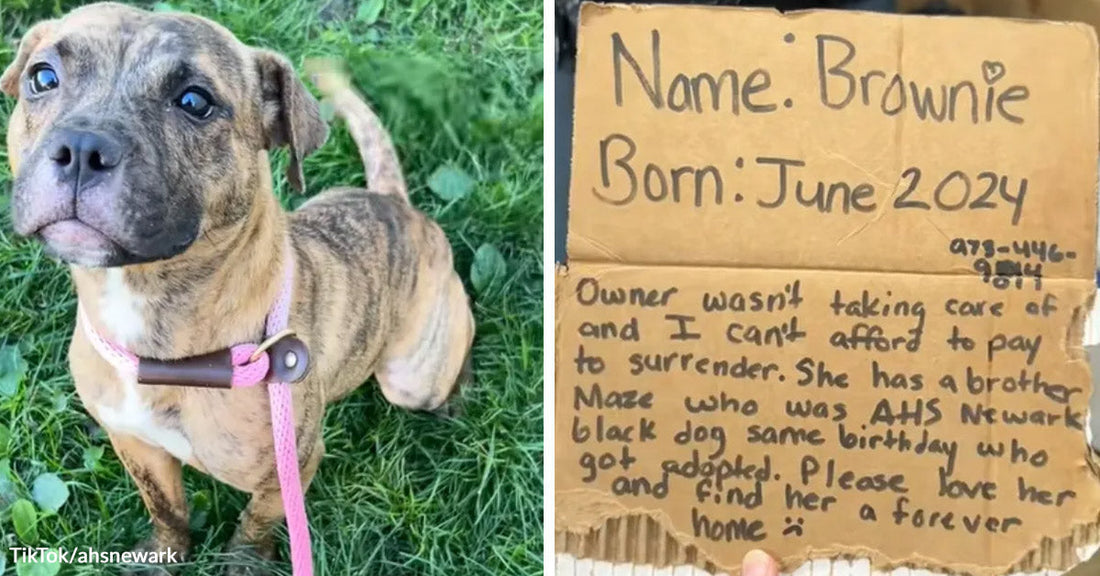
The story of Brownie, a young pit bull tied to a fence near a busy highway with a handwritten plea to “please love her,” is heartbreaking in its simplicity. It captures a growing crisis of abandoned dogs, overwhelmed shelters, and people who love their pets but feel they have no options left. As Brownie’s story spread across social media, it highlighted both the cruelty and the desperation at the center of so many animal abandonment cases.
Brownie was barely a year old when she was found near a very busy intersection and brought to the Associated Humane Societies Newark Animal Shelter in New Jersey. According to Olivia Gonzalez, the shelter’s social media manager, the young dog arrived with a scrap of cardboard that spelled out why she had been left behind. Her previous caretaker wrote that Brownie’s owner “wasn’t taking care of her” and that they could not afford the fee to surrender her to a shelter, then begged whoever found her to love her and help her find a forever home. That brief note, paired with the image of a dog tied alone by a highway, struck a chord with countless viewers.

In a video shared on the AHS Newark TikTok channel, Brownie was introduced as a dog who had already seen “some of the worst of what people can do” before her first birthday. Viewers saw an energetic, adorable pit bull who did not understand why her world had suddenly changed. The clip quickly gathered comments from people who were moved by her situation, calling her “the cutest” and hoping she would find a home soon. I found this detail striking because it shows how many people genuinely care yet often only see a small part of the wider problem.
The wider problem is substantial. According to data cited from the ASPCA, 60 percent of animals entering shelters in 2024 did so as strays. That broad category can include true strays with no known home, but it also covers many cases like Brownie’s, where financial hardship, housing issues, or family changes push people into abandoning animals in unsafe or unlawful ways. Gonzalez explained that, in recent years, AHS has seen an increase in stray, surrendered, and abandoned animals that closely tracks with the tough economic times many families are facing.
Those pressures ripple through every part of animal welfare. Families are struggling to cover the basics for their pets, including food, routine veterinary care, and emergency medical needs. Rising costs in general are compounded by a lack of accessible, pet-friendly housing. Breed discrimination adds another barrier for dogs like Brownie. As a pit bull, she belongs to a group that is often excluded by landlords or insurance policies, which can leave families feeling cornered when they need to move or when their housing situation changes suddenly.
Gonzalez noted that abandoning a domestic pet is unlawful, and leaving a dog tied by a highway is undeniably dangerous. Yet she also suggested that Brownie’s family likely acted out of desperation. That nuance is important when thinking about animal abandonment. It does not excuse the act, but it helps explain why shelters are seeing more pets left in parks, outside churches, or even right outside shelter doors overnight. In the past year alone, AHS has documented multiple cases of dogs tied up and left in public spaces and domestic cats turned loose on the streets with no way to fend for themselves.
The pressure on shelters themselves is intense. At AHS, demand has grown so sharply that the waitlist for owner surrenders stretches well into February 2026, with more than 80 dogs already in line for placement. That sort of backlog means many people in crisis cannot find legal, supported ways to rehome their animals when they most need help. Some will manage to place their pets with friends or family. Others, facing tight deadlines or strict housing rules, may feel they have nowhere to turn.
Brownie’s personality made her situation especially challenging. Gonzalez explained that her high energy did not mix well with spending 23 hours a day in a kennel. Even with dedicated staff and volunteers working hard to provide enrichment and exercise, a shelter can be an incredibly stressful environment for a young, active dog. Moments of play and human interaction are important, yet they are still brief breaks in a long day spent behind kennel doors. For many dogs, that environment becomes harder to tolerate the longer they stay.
In Brownie’s case, social media made a tangible difference. The TikTok video from AHS Newark reached a large audience and generated a wave of compassion. Comments poured in, not only praising her sweetness but also expressing a hope that she would be safe and loved. That attention did exactly what the shelter had hoped. Gonzalez shared that, thanks to the wide reach of the video, Brownie’s stay at the shelter was “short and sweet.” A dog who might otherwise have waited months for the right adopter found her new life far more quickly.
However, Brownie’s fortunate outcome is not the norm, and AHS was careful to point this out. While spotlighting her story, Gonzalez also introduced another dog named Randy, who has been in the shelter’s care for more than 400 days. Randy is currently the longest resident at AHS, embodying the quieter reality of shelter life for dogs who do not go viral. He represents the many animals who wait week after week for a family to choose them, even as puppies and social media favorites come and go.
The emotional contrast between Brownie and Randy underscores an important truth: every dog in the shelter has a story, even if it never appears in a video. The story of Brownie being abandoned with a note near a highway is powerful, and it encourages people to reflect on how economic forces, housing policies, and a lack of accessible support contribute to rising stray and surrender rates. At the same time, it also highlights how everyday acts of attention and advocacy, such as sharing a post or visiting a shelter, can change an individual animal’s fate.
Brownie’s experience of being abandoned, sheltered, and ultimately adopted is both heartbreaking and hopeful. It shows how a simple cardboard plea to “love her” can resonate with thousands of strangers. It also serves as a reminder that behind every kennel door is another Brownie or Randy waiting for a chance. For shelters, volunteers, and adopters, the challenge is to translate moments of viral empathy into long-term commitment, so that more abandoned dogs find the safe, permanent homes that every animal deserves. Read more at Newsweek