
Blind Man Escaped 78 Floors of the North Tower With His Guide Dog Leading Every Step
Guest Contributor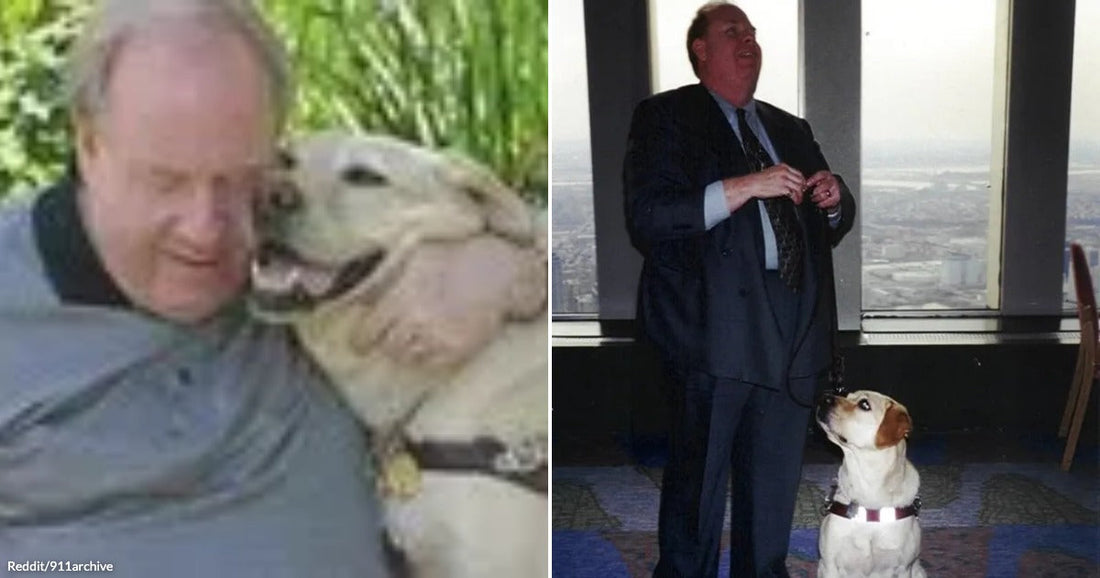
On the morning of September 11, 2001, a blind man and his guide dog began what seemed like an ordinary workday on the 78th floor of the North Tower. Within minutes, they were living through one of the most harrowing moments in modern history. The story of how Michael Hingson and his guide dog Roselle made it down 78 floors of the North Tower on 9/11 is both deeply sobering and powerfully uplifting. It stands out as a rare account of calm, trust, and courage amid chaos, and it remains one of the most remarkable guide dog stories to come out of that day.
Hingson had been blind since birth, so he approached the world using sound, touch, and spatial memory instead of sight. He also took emergency preparedness seriously. As the local leader of Quantum Corporation’s New York office, he made sure he understood the World Trade Center’s emergency procedures in detail. That awareness would prove crucial when a sudden, muffled boom shook the building and the tower lurched violently beneath him.

Reddit/911archive
In the moments immediately after the impact, a colleague, David Frank, ran to the window and saw flames, heavy smoke, and debris falling past the glass. Frank grew frantic, shouting that they needed to leave at once and reminding Hingson that he could not see what was happening. Inside the office, however, Roselle woke from under Hingson’s desk and calmly awaited direction. The yellow Labrador Retriever showed no sign of panic. Her quiet composure suggested that there was time to evacuate in an orderly, deliberate way, not in a stampede.
Relying on his knowledge of the building’s procedures, Hingson focused on getting everyone to the stairs instead of the elevators. After calling his wife to say that there had been an explosion and that he needed to leave the building, he urged Frank to help steer their coworkers to the stairwell. Once in the stairs, another chilling detail emerged. As they began their descent, Hingson detected a smell he recognized from airports: jet fuel. That realization confirmed that something far more serious than a routine fire or minor accident was unfolding above them.

Reddit/911archive
The group faced more than 1,460 steps between the 78th floor and the ground. As they moved down flight after flight, they encountered burn victims and other injured people also attempting to escape. One woman had difficulty breathing and was convinced they would not survive. Hingson and about eight others paused on the stairs to form a group hug and offer encouragement, trying to steady her emotions. Roselle added her own comfort, licking the woman and providing a small moment of warmth in an otherwise terrifying environment.
As they continued, firefighters climbed past them, heading upward toward the flames. Many reached out to give Roselle a quick pat in passing, a human gesture of connection that, in retrospect, may have been among their last moments of simple joy. The stairwell held a mix of fear, urgency, and determination as people tried to move efficiently without letting panic overtake them.
Near the 50th floor, fear flared again. Frank became overwhelmed and stopped, declaring that they were all going to die. Hingson responded sharply, insisting that if he and Roselle could keep going, so could everyone else. That straightforward challenge, grounded in the visible steadiness of the guide dog and the calm resolve of her handler, helped to pull the group together again. Hingson’s steady words to Roselle as they descended became a quiet anchor for the people around them.
Eventually, they reached the main lobby. Even there, the danger was not over. Officials advised people not to exit through certain doors, as debris, including bodies, was still falling outside. Hingson and the others moved into the central complex instead, searching for a safer path out of the building. They managed to find another exit that allowed them to leave without stepping directly into the deadliest zone of falling wreckage.
Only once outside did the full scale of the attacks become clear. Frank could see that both towers were on fire. At Vesey Street and Broadway, just a block away, he stopped to take a photograph, trying to capture what he was witnessing. It was then that Hingson heard a massive roar, one he later likened to both a freight train and a waterfall. The South Tower had begun to collapse.
Everyone turned and ran. For Hingson, the world dissolved into sound, motion, and choking dust. He described the debris as so thick that he could feel it pouring into his lungs. In that storm of confusion and falling ash, he trusted Roselle completely. When she stopped abruptly, he knew there had to be a reason. Guide dogs are trained to halt when a path becomes unsafe. Reaching ahead, Hingson felt a railing. Roselle had led him to a set of stairs that descended into a subway station.
They went down into the station, where the air was clearer. That small shift in location provided a crucial chance to breathe and regroup. Just about ten minutes after Hingson and Roselle emerged from the subway, the North Tower collapsed. In the aftermath, Frank described to him a skyline with no World Trade Center, only towering columns of smoke rising hundreds of feet into the air.
Back home in New Jersey later that day, Hingson removed Roselle’s working harness. The Labrador’s response was a reminder of her dual nature as both serious service dog and beloved family pet. Rather than collapsing in fear, she grabbed her favorite toy and signaled that she was ready to play. She had taken her responsibilities with absolute seriousness during the crisis. Once the work was done, she returned to being a regular dog in a familiar home.
In the months that followed, the account of how a blind man and his guide dog escaped the World Trade Center spread widely. Hingson and Roselle appeared on television and radio, and their journey came to be seen as a powerful example of trust between a handler and a service animal. In 2002, Roselle received an American Kennel Club award for canine excellence in the service dog category, an acknowledgment of her calm bravery on a day marked by terror.
In 2004, Roselle was diagnosed with immune-mediated thrombocytopenia, a disease that affects blood platelets. Hingson believed that the toxic air conditions Roselle experienced while helping him escape on 9/11 may have played a role in her illness. Even with that diagnosis, she lived for seven more years, surrounded by the family that loved her. On June 26, 2011, Roselle passed away peacefully, with Hingson by her side, just as she had been by his during the most dangerous hours of his life.
Over the course of his life, Hingson has worked with several guide dogs, each serving as an essential partner in independence. Yet his bond with Roselle occupies a special place in his story. As he has explained, his job was to know where to go and how to get there, and Roselle’s job was to guide him there safely. On September 11, 2001, that partnership was tested in the extreme. He never let go of her harness, and she never faltered in leading him down 78 floors of the North Tower on 9/11 and through the chaos that followed.
Read more at https://allthatsinteresting.com/michael-hingson