
🚨Urgent: Missile Strikes Shelter in Ukraine! Rush Emergency Aid!
Starving Baby Bird Was Too Weak to Eat Until His Feathered Roommate Stepped In
Guest Contributor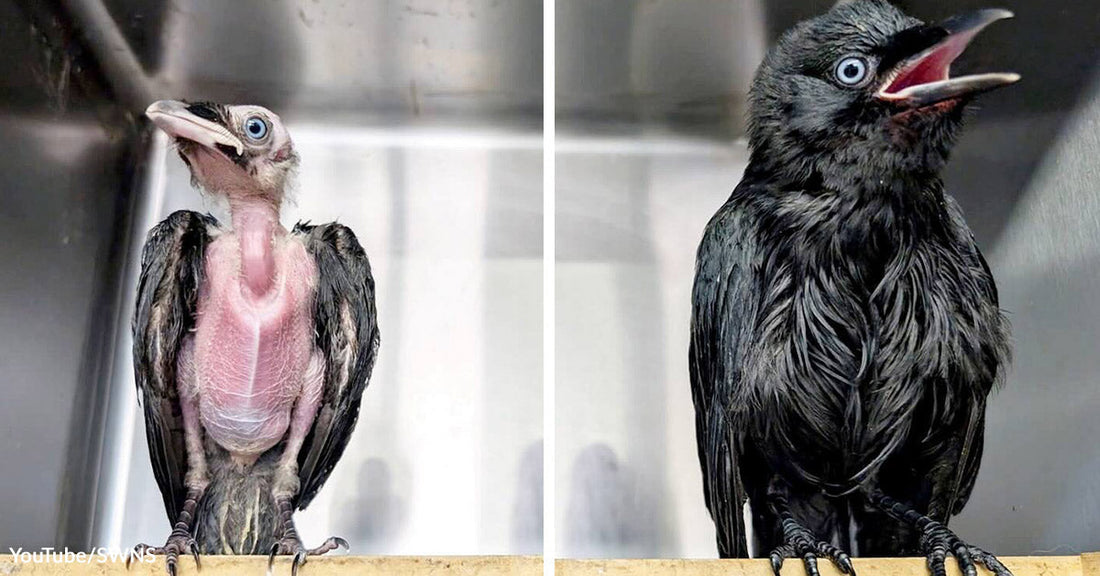
A tiny, starving jackdaw rescued from a field in Nottingham is capturing hearts far beyond the English countryside, thanks to an older bird that has stepped in as an unlikely teacher and surrogate parent. The tender relationship between the two rescued crows, especially the way the older fledgling gently feeds and guides the younger one, offers a moving look at animal compassion and makes this one of those rare, truly heartwarming animal rescue stories.
The younger bird, a baby jackdaw with scarcely any feathers, was found in what rescuers described as a “sorry state” and close to death. Discovered earlier this month in a field, he was severely underweight and clearly malnourished. Volunteers from Brinsley Animal Rescue brought him to their center, where his striking blue eyes inspired a memorable nickname. They called him Frank Sinatra, a nod to the famous singer’s iconic blue gaze, and the name immediately stuck among the team.

According to co-founder Jon Beresford, Frank is around six weeks old but noticeably small for his age because of the lack of proper nutrition. At a stage when a young jackdaw would ordinarily still rely heavily on attentive parents for regular feeding, Frank had instead been struggling alone. His arrival at the rescue center marked his first real chance at survival and recovery.
To support his fragile condition, Frank was placed in a recovery unit where he could be carefully monitored, quarantined for treatment, and protected from the elements. The team then made a seemingly simple yet significant decision. They housed him with another young jackdaw, slightly older and more advanced in its development, who had already begun learning to feed itself. No one at the center expected what would happen next.
Instead of competing for attention or food, the older jackdaw began acting like a guardian. Rescuers observed that Frank would frequently call out to his new companion, a behavior that mimics how young birds beg from their parents. Rather than ignoring these pleas, the older fledgling started responding in the most practical and nurturing way possible. It began feeding him.
That spontaneous act of care surprised the Brinsley Animal Rescue team. Beresford described how the older bird, still young and hardly an expert itself, took on the role of provider for the younger, weaker Frank. The older jackdaw had only just learned how to manage its own food, yet it instinctively began transferring bits of Frank’s meals into his beak. As Frank struggled with worms and seeds, the older bird guided him, helping him swallow and showing him what to do.

YouTube/SWNS
Adorable videos from the rescue center show the two birds perched closely together, with the older jackdaw gently feeding Frank and supervising his attempts at eating. For many viewers, these images highlight a touching display of avian empathy. Frank focuses intently on the older bird, reportedly watching his every move and copying the behaviors he sees, from how to handle food to how to interact with his surroundings. This kind of observational learning is essential for wild birds, and in this case, it may be the key to Frank’s survival.
The staff notes that this mentorship is doing more than just helping Frank gain weight. Being housed with a slightly older bird appears to be aiding his overall development, both physically and behaviorally. In the wild, a young jackdaw would learn not only what to eat, but also how to forage, how to respond to sounds and movement, and how to interact with other members of its species. In the safety of the rescue center, this older fledgling has become a stand-in for those lost parents, offering Frank an improvised but effective education.

YouTube/SWNS
Stories like this one remind many people of other surprising interactions between humans and wild birds, from rescue tales to ongoing cross-species friendships. The source that reported Frank’s journey also highlights other examples of remarkable avian behavior, including a woman who rescued an injured crow and later began receiving what appeared to be “thank-you gifts” from wild birds, as well as the sale of Scotland’s Bass Rock by a family determined to protect a vast seabird colony. In each case, the focus is on cooperation and care, whether between people and birds or, in Frank’s situation, between birds themselves.
Back in Nottingham, the hopeful trajectory of this baby crow’s story now rests on continued recovery. With regular meals, gentle handling, and the unexpected support of his feathered mentor, Frank is already defying the grim condition in which he was found. Rescuers at Brinsley Animal Rescue plan to move him into an aviary once he grows stronger. There he will have the space and structure he needs to learn how to fly, build up muscle, and practice the survival skills necessary for life outside human care.
The ultimate goal for Frank is re-release into the wild, a milestone that depends on both his physical health and his ability to behave like a wild jackdaw. The older fledgling’s guidance may therefore play a crucial role, since watching another bird and copying its behaviors gives Frank a better chance of functioning independently when that time comes. It is a quiet but powerful example of how social learning in animals can shape outcomes, particularly in rehabilitation settings.
For anyone who cares about animal welfare or simply enjoys uplifting wildlife stories, the sight of one vulnerable bird patiently nurturing another is a compelling reminder that compassion is not limited to humans. I found this detail striking. The older jackdaw, with no prompting, took the initiative to care for a weaker companion, mirroring the kind of caregiving behavior usually associated with parents or experienced adult birds. The fact that it came from a youngster that had only just secured its own feeding skills makes the story all the more affecting.
As Frank continues his journey from a “sorry state” in a field to a confident young jackdaw ready to take to the skies, the partnership between these two rescued birds offers a hopeful message. It shows how a combination of human intervention, suitable habitats like rescue centers and aviaries, and the instincts of animals themselves can converge to give a fragile life another chance. Watching an older crow take it upon itself to teach a starving orphan how to eat is not only endearing. It is a small but powerful testament to the resilience and interconnectedness that exist within the natural world.