
Terrified Rescue Dog Finds The Courage To Heal After A Tiny Kitten Walks In
Guest Contributor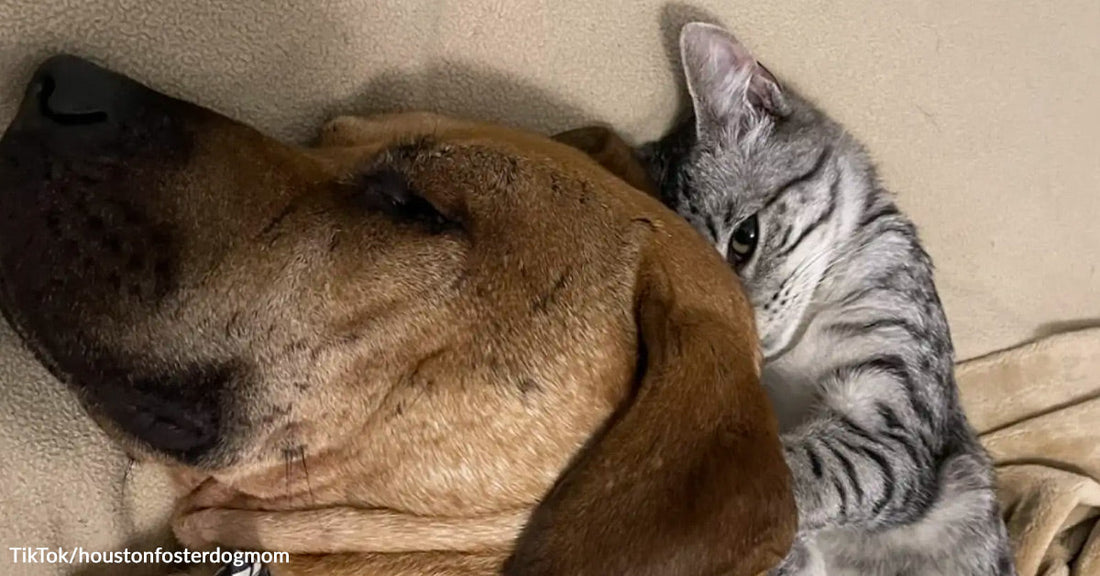
A rescue dog too scared to step outside discovering courage through a tiny kitten sounds like something from a children’s book, yet it is exactly what happened to Chapo, a dog who went from terrified and shut down to confident and nurturing. Stories about a rescue dog and kitten friendship are common online, but this one captures an especially moving transformation. It shows how healing can travel both ways between animals, and how a gentle presence can unlock trust where fear once ruled.
Chapo’s life before rescue was marked by hardship. According to his caregiver, Claudia Papp, he had survived an abusive situation and then landed on a shelter’s euthanasia list. When Papp chose to foster him through Diamonds in the Ruff Animal Rescue, she quickly realized she was bringing home more than a standard foster dog. Chapo arrived physically damaged and emotionally frozen. He had fleas, worms, a skin infection and fractured teeth. The visible injuries were troubling enough, but it was his behavior that revealed the depth of his trauma.

For days, Chapo could not even move toward the person who was trying to help him. Papp recalls that he spent the entire first night standing at the back door, just staring at it, too nervous to explore or settle. He did not approach her for at least five days. Even as time passed and he presumably began to understand that he was safe from immediate harm, fear had a deep hold on him. At five months in, he was still too scared to take a simple step outside into the backyard. Many rescue stories describe a quick, joyful adjustment once an animal is adopted. Chapo’s slow progress shows that healing after trauma often takes far longer than people expect.
Despite this, there was something about Chapo that made it impossible for Papp to see him as just another foster placement. She had already fostered 47 dogs, a remarkable number that suggests extensive experience with a wide range of personalities and behaviors. Yet she described Chapo as particularly gentle and soulful. Those qualities made it difficult to imagine handing him off to another family, and eventually she stopped trying to imagine it at all. Chapo became her first “foster fail,” a term many animal lovers use affectionately for the moment a foster animal becomes a permanent member of the household.

Life at home slowly took shape around Chapo’s sensitivities. He was not bold, not carefree, and certainly not outgoing. However, one clue to a different side of him appeared in his interactions with Papp’s resident cat. He handled the cat with a calm, respectful demeanor, which hinted at a latent nurturing instinct beneath all that fear. That gentle bond laid the groundwork for one of the most important relationships of Chapo’s life: his friendship with a foster kitten named Cecily.
When Papp decided to foster Cecily, a kitten in need of a temporary home, Chapo’s reaction was immediate. He seemed drawn to Cecily’s energy from the start. While he was quiet and cautious, Cecily embodied typical kitten enthusiasm: playful, curious and free of fear. The kitten, for her part, trusted Chapo, perhaps sensing that his calmness meant safety. Their dynamic was not one of a big threatening dog and a fragile kitten. Instead, it was a kind of mutual recognition, with Cecily’s exuberance complementing Chapo’s stillness.
What followed highlights the extraordinary emotional influence animals can have on one another. After only two weeks of living with Cecily, Chapo did something he had never done in his entire time with Papp. Without coaxing or special prompting, he simply got up, walked to the door and went out into the backyard on his own. For a dog who had been too frightened to cross that threshold for months, this was a radical shift. Papp attributed this new confidence to Cecily’s presence, describing it as a level of courage he had never shown before.
I found this detail striking because it illustrates how social learning and emotional safety can come from unexpected sources. Humans had provided Chapo with medical care, time and patience, yet a small kitten’s playful confidence seems to have offered the final encouragement he needed. It is a reminder that some forms of fear are not overcome by direct pressure or training, but by quiet, consistent examples that say, “The world is safe enough to explore.”
Recognizing Cecily’s positive impact, Papp chose to keep fostering kittens. Over time, the pattern repeated. Chapo met more kittens, each with their own personality and energy, and with every new friendship he seemed to discover another piece of himself. He grew more comfortable, more self-assured and increasingly affectionate. The rescue dog who once froze at the back door became a dog who could not only move through his world with more ease, but could also serve as a gentle anchor for much smaller, often fragile animals.
The kittens provided more than emotional support. They also served as role models. Chapo began to imitate their movements, as if their bodies were teaching him how to inhabit his own. When a kitten would roll onto their back, he would mirror them and roll as well. When they stretched their legs in a leisurely way, he stretched his too. This mimicry had a playful edge, but it also suggested new patterns of relaxation. It was as if he was practicing being comfortable, one copied stretch at a time.
Many of the kittens who came through Papp’s home were dealing with health challenges. They needed extra attention, medical care and a calm presence while they healed. Chapo, who had arrived in the home sick and afraid, became one of their quiet caregivers. Papp described him as having a nurturing ability that felt almost mysterious, especially given the lack of kindness in his early life. The person who had him before had not modeled gentle behavior for him, yet he offered it naturally to the kittens. It stands as a powerful counterpoint to the idea that cruelty must always be passed on.
As the years passed, the balance of Chapo’s life shifted. Four years after entering Papp’s home, he reached a significant milestone. He had now spent more time living in a loving environment than he had in his previous life. That change in ratio carries symbolic weight. His story became less about escape from harm and more about the accumulation of safe, ordinary days filled with backyard walks and kitten company.
Papp described his progress as beyond what she had imagined possible for him. The dog who once could not walk toward her and who trembled at the idea of stepping outside had transformed into an animal capable of trust, care and play. The many foster kittens he helped along the way were both his students and his teachers. In guiding them through illness and insecurity, he reinforced his own sense of security.
Stories like Chapo and Cecily’s highlight the quiet power of companionship and the remarkable resilience of animals who have every reason to give up on the world yet do not. For anyone involved in animal rescue, fostering or adoption, their bond offers a hopeful reminder that healing does not always follow a straight or predictable line. Sometimes it arrives on soft paws, wrapped in kitten energy, and changes everything.