
🚨Urgent: Missile Strikes Shelter in Ukraine! Rush Emergency Aid!
Mad Jack Churchill, The World War II British Commando Who Fought With A Sword and Played Bagpipes
Guest Contributor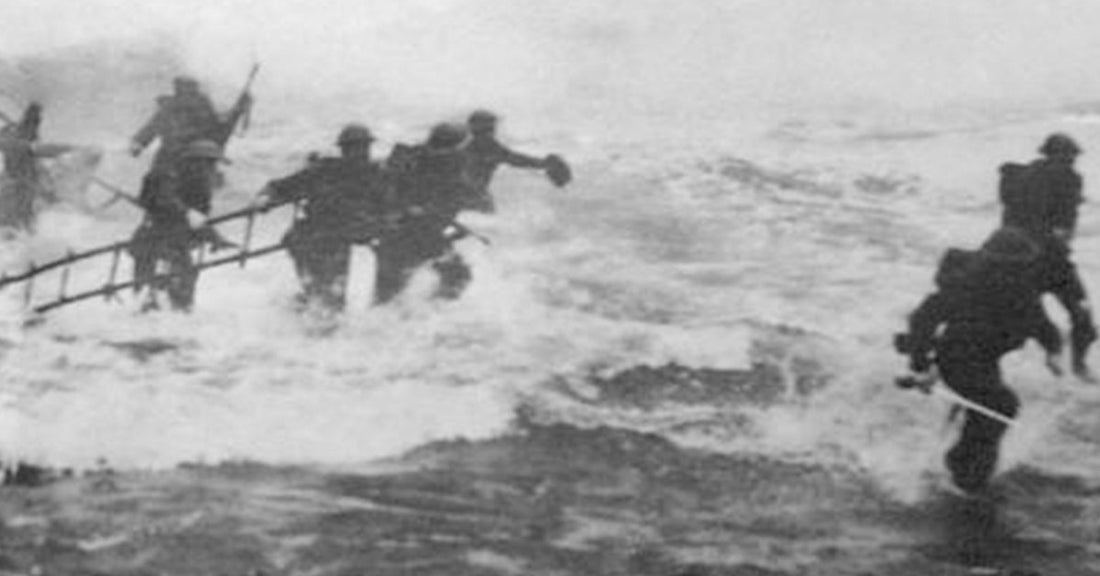
During World War II, when modern warfare was defined by tanks, machine guns, and the dawn of atomic weaponry, one British soldier stood out for his archaic and eccentric combat style. Lieutenant Colonel John Malcolm Thorpe Fleming Churchill, better known as "Mad Jack" Churchill, refused to enter battle without his Scottish broadsword, longbow, and bagpipes. His story is a remarkable blend of bravery, unconventional tactics, and a fierce dedication to personal code—making him one of the most legendary figures of the Second World War.

Mad Jack Churchill believed that "any officer who goes into action without his sword is improperly dressed." This wasn’t a metaphor. He literally charged into battle wielding a basket-hilted broadsword, often while playing his bagpipes. His unique approach to warfare, combined with his undeniable courage, made him a standout among British commandos and a lasting symbol of individualism in military history. The keyword phrase “British commando World War II” captures just a glimpse of his extraordinary role.

Born in 1906 in Hong Kong, Churchill's early life was shaped by exploration and adventure. His family returned to England in 1917, but the young Churchill's thirst for excitement never waned. After graduating from the Royal Military College at Sandhurst in 1926, he was stationed in Burma with the Manchester Regiment. There, he developed a passion for long motorcycle rides and learned to play the bagpipes—skills that would later become part of his battlefield persona.
In 1936, Churchill left the army and moved to Nairobi, Kenya, where he worked as a newspaper editor and male model. He also ventured into film, showcasing his archery and piping skills in movies like The Thief of Bagdad and A Yank at Oxford. His talents earned him a spot in the World Archery Championships in Oslo, representing Britain. But the outbreak of World War II in 1939 pulled him back into military service, setting the stage for his most legendary exploits.
Churchill rejoined the British Army as part of the British Expeditionary Force in France. In one extraordinary encounter, he ambushed a German soldier with a barbed arrow, earning the distinction of being the only British soldier known to have killed an enemy with a longbow during the war. According to Vice, this was also the last recorded longbow kill in history—a striking reflection of Churchill’s unique place in modern combat.
Volunteering for the newly formed Commandos, Churchill quickly became known for his dramatic battlefield entrances. He would often play the bagpipes as he led charges, sword in hand, and lobbed grenades at enemy positions. During one raid in Sicily, Churchill and a corporal managed to capture 42 German soldiers using only his sword and the element of surprise. For his valor, he was awarded the Military Cross and Bar.
Despite his frequent brushes with death, Churchill seemed almost untouchable. On one occasion, a mortar shell wiped out his entire team during a raid, but Churchill survived—he had been away from the camp playing his bagpipes. Captured by the Germans, he was sent to Sachsenhausen concentration camp. True to form, he escaped by crawling under a fence and through an abandoned drain. He made it nearly to the Baltic coast before being recaptured. Eventually released by a sympathetic German unit, he walked 93 miles to Verona, Italy, to rejoin Allied forces.
Churchill’s wartime adventures didn’t end there. In 1944, he was deployed to Burma to fight the Japanese. However, by the time he arrived, the atomic bombings of Hiroshima and Nagasaki had brought the war to a close. Reportedly disappointed, Churchill lamented, “If it wasn’t for those damn Yanks, we could have kept the war going another 10 years!” While clearly tongue-in-cheek, the remark reflects his enduring appetite for action.
After the war, Churchill continued to seek out new challenges. He qualified as a parachutist and served in British-occupied Palestine, where he coordinated rescue efforts for civilians under attack. Later, he moved to Australia to teach at a military school and took up surfing. Upon returning to England, he became the first person to surf the tidal bore of the River Severn.
Even in retirement, Churchill remained as eccentric as ever. He famously threw his briefcase out of the train window each day to avoid carrying it home from the station—he aimed it into his backyard. He also enjoyed sailing the Thames and playing with radio-controlled model warships. I found this detail striking; it illustrates how deeply his sense of play and adventure endured, even after a life filled with real-life heroics.
Mad Jack Churchill passed away in 1996 at the age of 89. His legacy lives on not only as a soldier who defied convention but as a man who lived life entirely on his own terms. From wielding a sword in modern warfare to escaping concentration camps and surfing river bores, Churchill’s life reads more like legend than history. Yet every account confirms that this extraordinary figure was very real—and wholly unforgettable.