
Firefighters Give Oxygen to Distressed Pigeon After It Approaches Them Begging for Help
Guest Contributor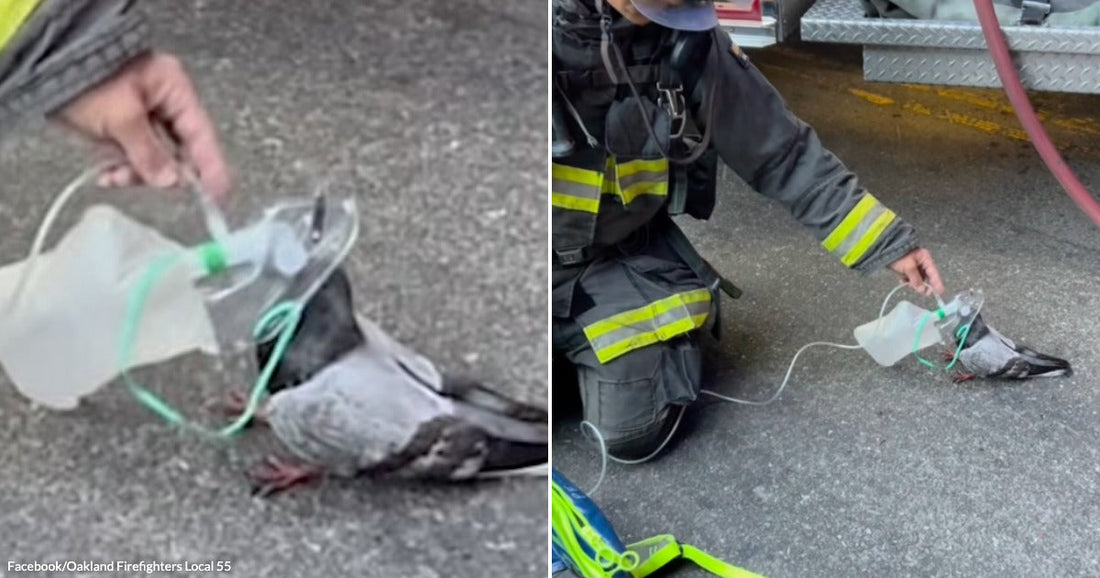
Video of a firefighter gently holding a small oxygen mask to a pigeon’s beak has captured millions of views, and it is easy to see why. In the middle of a routine emergency response to a vehicle fire in East Oakland, the E29 crew of Oakland Firefighters paused to help an unexpected victim: a pigeon that appeared to be struggling after inhaling smoke. The quiet tenderness of that moment, with a firefighter offering oxygen to a pigeon to clear its lungs, stands out amid images of sirens and flames and has sparked a wider conversation about the often overlooked bond between humans and city birds.
According to the Oakland Firefighters Local 55 Facebook page, the crew had just finished responding to a vehicle fire on a Wednesday evening when they noticed the pigeon. The firefighters observed that the bird approached them and seemed to be in distress. The crew believed the pigeon had suffered smoke inhalation related to the East Oakland vehicle fire, and rather than simply shooing it away, they chose to act. One firefighter carefully positioned an oxygen supply near the pigeon so it could breathe more easily. After a short period, the bird recovered enough to fly away, as the firefighters described it, “after clearing out its lungs.”

The scene is simple yet powerful. A large figure in heavy turnout gear crouches down, holding a life-saving tool typically reserved for people, while a small, soot-dusted pigeon accepts the help. It is not a rescue that will make the official statistics for saves or injuries prevented, but it clearly resonated with viewers. The clip spread quickly across social media, and comments poured in from people who saw in the pigeon’s behavior a kind of trust that is easy to underestimate.
Several commenters focused on a point that often goes unmentioned in conversations about so-called “city birds.” They noted that pigeons are actually domesticated animals that have lived alongside humans for thousands of years. As one commenter, Katherine Linville, wrote, humans domesticated pigeons, so they are accustomed to being around people and, in many ways, are drawn to them. She suggested that the pigeon’s decision to walk up to the firefighters seeking help reflects this long history of coexistence, adding affectionately, “Sweet little birds.”
Another commenter, Taj-Ma R. Carter, saw the moment as evidence of the bird’s trust. They remarked that the pigeon appeared to recognize the firefighter as a life saver, observing that pigeons watch humans closely and know us well. This idea challenges the notion that pigeons are indifferent background creatures in urban life. Instead, it suggests they are actively observing, adapting, and making choices based on what they learn about the people around them.
Commenter Mai Caroline took the thought a step further by reflecting on the long relationship between humans and pigeons. They wrote that humans and pigeons “had bonds” and described pigeons as “ridiculously smart creatures.” That description aligns with a growing awareness of animal intelligence, particularly among birds. While the article itself keeps the focus on the specific event and the internet’s reaction, this brief remark hints at a broader story about how much more complex these familiar birds might be than many assume.

Facebook/Oakland Firefighters Local 55
I found this detail striking because it turns a common stereotype on its head. Pigeons are often dismissed as pests, yet here they appear as intelligent beings able to recognize safety and seek assistance. The firefighter’s simple act of offering oxygen to a struggling animal became a kind of proof that compassion can extend beyond our own species, even in the most hectic moments of an emergency response.
The viral video also underscores the everyday humanity within professions that the public usually sees only in crisis. Firefighters train extensively to respond quickly and efficiently to dangerous situations. Their work typically revolves around protecting human life and property from fire. Yet when the immediate danger passed and they noticed a vulnerable animal in distress, they still took a moment to help. They did not have to do it, and there was no guarantee the effort would succeed. They simply recognized suffering and responded.
That quiet decision resonated with people who watched the clip online. It served as a reminder that kindness can appear in unexpected places and that empathy often shows itself in small, unplanned actions. The crew’s choice to give oxygen to a pigeon with smoke inhalation became a story not only about animal rescue, but also about the values that guide those working on the front lines of emergencies.
The incident has also inspired many viewers to reconsider how they see pigeons in general. Comments about pigeons being domesticated animals, comfortable around people and capable of trust, invite a different kind of attention the next time someone notices a bird perched on a railing or walking through a city plaza. Instead of assuming they are simply scavengers, some might now remember that people once relied on pigeons for communication, messaging, and companionship. The mention of a World War II pigeon parachute used to carry messages to the French Resistance before D-Day hints at this long history of cooperation and service.
Stories like this one often gain traction because they offer a brief, uplifting counterpoint to more troubling news. Witnessing a firefighter treating a pigeon with the same care and calm he might offer a human patient speaks to a shared desire to see gentleness and responsibility in action. The fact that the pigeon accepted help and then flew away made the narrative feel complete, a small, satisfying arc that ends with recovery and freedom.
At the same time, the reactions to the video reveal how deeply people want to celebrate connections between humans and animals. From calling pigeons “sweet little birds” to emphasizing their intelligence and trust, commenters framed the event as something more than a quirky viral moment. For many, it symbolized respect for life in all its forms and a recognition that our cities are shared spaces, full of nonhuman neighbors who notice us as much as we notice them.
In the end, the sight of a pigeon walking up to firefighters and receiving oxygen to clear its lungs is memorable precisely because it feels both unusual and entirely natural. It reflects a simple equation: an animal in distress, a group of trained responders, and an opportunity to help. The firefighters responded as they are trained to do, by offering assistance, and the pigeon responded in turn by trusting them. The result was a short video that invited millions of people to pause, look a little more closely at a familiar bird, and perhaps carry a bit more compassion into their own daily lives.