
🚨Urgent: Missile Strikes Shelter in Ukraine! Rush Emergency Aid!
Tourists Spark Global Fury After Filming Themselves Riding a Sea Turtle as She Lays Her Eggs
Guest Contributor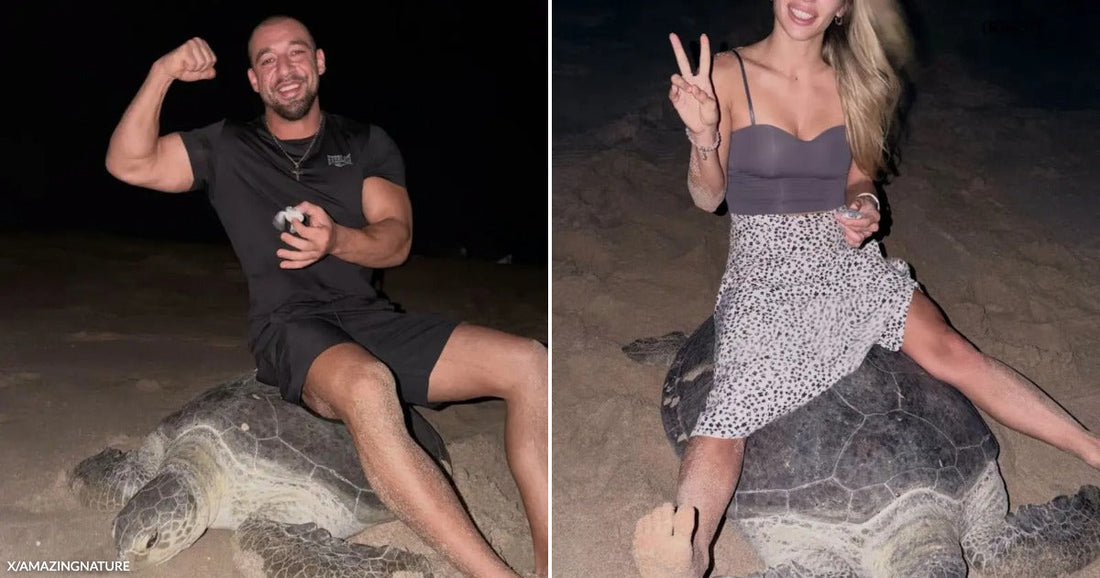
Outrage is rippling across social media after a Ukrainian couple filmed themselves riding an egg-laying sea turtle in Oman, igniting a fierce international backlash and a renewed conversation about wildlife tourism. The disturbing footage, which shows the pair taking turns sitting on a nesting turtle, has quickly become a viral example of how “scum of the earth” tourists can harm fragile ecosystems and vulnerable animals while chasing clicks and attention.
The incident unfolded at Ras al Hadd, a coastal area in Oman known as a sanctuary for several species of sea turtles that come ashore to nest. According to reports, fitness influencer Vadym Oleynik, 32, and his partner, cosmetic doctor Olena Kravchenko, were visiting the site accompanied by environmental volunteers who monitor the beach. Instead of quietly observing this significant natural event, the couple turned it into a spectacle.

X/AMAZINGNATURE
Viral photos showed Oleynik and Kravchenko each sitting on the back of a nesting sea turtle while the animal was in the process of laying its eggs. In one particularly alarming clip, Oleynik can be seen trying to maintain his balance on the turtle’s shell while holding a hatchling in his hands. The egg-laying turtle and the small hatchling, both in vulnerable states, were reduced to props in a stunt intended for social media engagement.
The reaction online was immediate and ferocious. Viewers condemned the pair’s behavior as cruel and reckless, accusing them of abusing an innocent animal purely for laughs and online attention. One commenter on X captured the prevailing sentiment, calling them “sick scum of the earth,” while another insisted that their behavior deserved punishment. The anger was not only about the single act, but about what it symbolizes: a pattern of tourists disregarding basic respect for wildlife in exchange for a dramatic photo or video.
Conservation advocates also reacted strongly. Italian conservation project Biologicamente, which helped bring the incident to wider public attention, criticized not only the couple but also the organization that allowed such behavior to occur. In a pointed statement on Facebook, Biologicamente argued that any serious and professionally run association, especially one supported by a scientific committee, would never allow volunteers or visitors to sit on a turtle’s shell just to snap a selfie. They described the scene as an “abhorrent level of ignorance,” underscoring how deeply at odds such actions are with accepted standards of wildlife protection.
From a conservation perspective, interfering with nesting sea turtles is especially troubling. These animals already face threats from habitat loss, pollution, fishing bycatch, and climate change. Nesting and hatching are sensitive periods, and disturbance can cause stress, disrupt egg-laying, or even drive turtles back to the sea before they have deposited their eggs. While the article stayed focused on the incident itself, this broader context helps explain why viewers and experts treated the footage as more than a harmless misstep.

X/AMAZINGNATURE
The outrage did not remain confined to social media. Oman’s Environmental Authority stated that the couple’s actions violated the country’s wildlife protection laws and announced that it had taken the “necessary legal action” against those involved. Local media reported that this behavior could put both the turtles and their habitat at risk, reinforcing how seriously authorities take such violations. Some outlets suggested that Oleynik and Kravchenko had been detained, though these reports remained unverified while Oleynik continued posting vacation photos after the incident.
Oleynik, who frequently shares fitness content with his more than 200,000 Instagram followers and describes himself as a Master of Sport in the Russian martial art of combat sambo, responded to the backlash with an apology. He claimed that he had been misled by the organization overseeing the turtle site and insisted that he had not intended to harm the animal. He also said he had not seen any rules and acknowledged that he had made a mistake, apologizing “to everyone.”
Even with that apology, the episode has raised serious questions about responsibility at every level. Many critics focused on the couple’s individual choices and apparent disregard for an obviously vulnerable animal. Others, like Biologicamente, pointed to the environmental organization that permitted visitors and volunteers to get close enough to ride a nesting turtle at all. If proper guidance, education, and supervision were in place, they argued, scenes like this should never occur.
I found this detail striking because it reveals a gap between the image of eco-conscious tourism and the reality on some ground-level tours. A setting can be marketed as a conservation experience while still failing to protect the very animals it claims to showcase. When tourists see volunteers or staff allowing certain behaviors, they may perceive them as acceptable, even when they are actually harmful.
At a cultural level, the “fit-fluencer” aspect of the story also struck a nerve. The fact that these images were created specifically for social media highlights how the pursuit of dramatic content can overshadow ethical judgment. The combination of a massive online audience, a fragile habitat, and a desire to stand out has repeatedly led to destructive behavior in natural settings. In that sense, this sea turtle incident is part of a broader pattern that includes everything from trespassing in protected areas to damaging delicate landscapes for the sake of a photograph.
Still, there is another side to the viral reaction. The passions stirred by the video illustrate how many people around the world care about animal welfare and environmental protection. The harsh language used by some critics reflects not only anger at the couple, but also a strong instinct to defend animals that cannot speak or advocate for themselves. Intense public scrutiny, paired with clear enforcement by local authorities, can serve as a deterrent to others who might contemplate similar stunts.
Ultimately, the Ras al Hadd incident is a sharp reminder that wildlife is not a backdrop or a prop, even in places that welcome visitors. Sea turtles, especially when nesting or hatching, require distance, quiet, and respect. For tourists, the simplest guideline is often the most important: if interacting with an animal feels like a stunt, a joke, or a show, it is almost certainly not respectful wildlife tourism. The hope is that this case, and the anger it provoked, will encourage travelers, tour operators, and influencers to treat marine life and all wild animals with far greater care in the future.