
Paralyzed Shelter Cat Defies The Odds And Walks Again In An Astonishing Recovery
Guest Contributor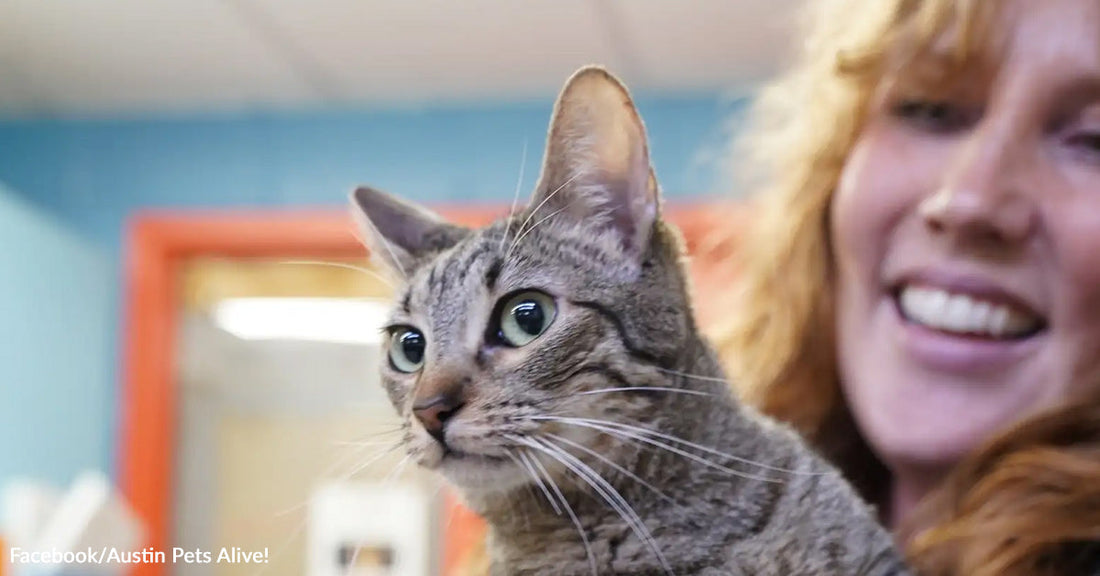
When rescuers at Austin Pets Alive! watched a paralyzed cat named Sally Skellington slowly push herself up, steady her legs, and take a few shaky steps, it felt like witnessing a small miracle. In a shelter world where progress can be painfully slow, seeing a once paralyzed cat walk again was more than just encouraging. It was a powerful reminder of resilience, the impact of veterinary innovation, and the quiet determination of animals who refuse to give up.
Sally’s story began like many happy adoption tales do. She left Austin Pets Alive! (often called APA!) for a loving home, where she was reportedly thriving. For a time she was simply a content family cat, settled into her new life. Then, without warning, everything changed. A few months after adoption, her family noticed that she suddenly stopped walking. The cat who had been moving around confidently now could not stand, and the shift was both frightening and confusing.

Her family rushed her to an emergency clinic, hoping for a quick diagnosis and treatment. Instead, they faced uncertainty. The team at the clinic could not immediately figure out what was wrong with Sally or why she had lost the ability to walk. Faced with mounting fears and the unknown nature of her condition, they made a difficult and emotional decision. Wanting Sally to get the best possible care, they surrendered her back to Austin Pets Alive! so the organization could focus on diagnosing and treating her.
According to Luis Sanchez, director of public relations and communications at APA!, Sally arrived back at the rescue just in time. Staff members soon discovered that she had FIP, or feline infectious peritonitis. For many years, FIP was widely regarded as a once fatal disease in cats, often associated with heartbreaking outcomes. Sanchez explained that Austin Pets Alive! has been pioneering treatments for FIP, giving cats like Sally a genuine fighting chance where previously there had been very little hope.

The diagnosis explained her sudden paralysis. FIP had taken away Sally’s ability to walk and nearly claimed her life entirely. At that point, it would have been easy to assume that her future would be limited or that she might never stand again. Instead, the staff at APA! committed to her care, drawing on their growing experience with FIP treatments. Over time, Sally slowly began to stabilize, then improve. In stories like this, the words “groundbreaking care” can sound abstract, yet in Sally’s case they translated directly into small, concrete changes. Her eyes brightened, her strength began to return, and the cat who once lay still and helpless started to move again.
The moment that captured so many hearts came when the team watched her take those first tentative steps. APA! shared the scene with their community, encouraging people to “stop scrolling to witness a miracle.” For most cats, walking is a simple everyday action. For Sally, each wobbling step across the room was a revelation. She walked a little sideways and a little shakily, but what mattered most was that she was walking at all.
Staff and volunteers at the shelter reportedly cheered her on, moved by what they were seeing. Here was a paralyzed cat walking again, defying expectations with every unsteady stride. The excitement was not about perfection. Her movements were far from smooth, but they signaled that the treatments were working and that Sally’s spirit had not dimmed. Sanchez noted that thanks to the cutting edge care she received, Sally was not only improving but actively regaining her strength.
Stories of a cat recovering from FIP can resonate strongly because they bring together scientific progress and emotional connection. For many years, a diagnosis of FIP meant preparing for loss. In this context, watching a cat with FIP stand and walk again feels extraordinary. I found this detail striking not just because of the medical breakthrough, but because it underscores how closely animal welfare organizations follow emerging treatments and how determined they are to translate those advances into second chances for individual animals.
As Sally continued to heal at Austin Pets Alive!, her future slowly transformed from uncertain to hopeful. At first there were more questions than answers. No one knew how fully she would recover, how long her therapy would take, or whether she would ever move like she used to. Over time, however, her progress showed that possibility is often wider than initial expectations suggest. Each day of practice on her wobbly legs helped her relearn balance and rebuild confidence. In that process, every small step forward became something worth celebrating.
The story did not end in the shelter. With her health stabilized and her mobility returning, Sally is now heading to a new forever home. Her adoptive family will help her continue this journey, encouraging her as she gains confidence and relearns how to walk more smoothly. She has already overcome the shock of paralysis, the uncertainty of a serious disease, and the upheaval of returning to a shelter. Now she will get the chance to grow stronger in a home of her own.
For anyone who cares about animal welfare, FIP stories like Sally’s illustrate a broader shift. Medical conditions once viewed as final are now, in some cases, treatable. That shift is made real not in statistics, but in individual animals who go from lying still on a blanket to taking a few uncertain but determined steps across the floor. Watching Sally walk again reminds people that resilience is not reserved for humans. Animals, given compassion and appropriate care, often find ways to adapt, heal, and surprise the people around them.
Sally’s journey from happily adopted pet, to suddenly paralyzed cat, to FIP patient in intensive care, and finally to wobbly yet hopeful walker on her way to a new forever home, offers a quiet but powerful message. Progress can look small and unsteady at first. It can lean to one side, falter, and try again. Yet it still counts. For Sally, every sideways, shaky step is a sign that her story is still being written and that the future in front of her is brighter than anyone dared to predict on the day she stopped walking.