
Rescue Beagle Discovers A Ball And A Whole New World
Guest Contributor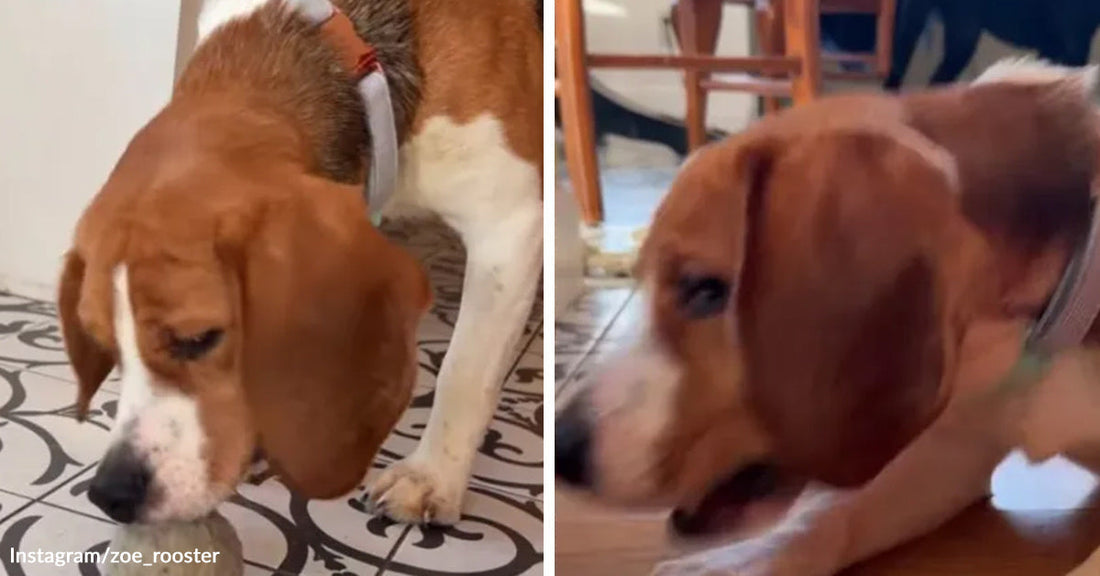
For many companion animals, chasing toys and sprinting across a yard feels as natural as breathing. Yet for some rescue dogs, especially those who spent their early lives in cages, the simple act of batting at a ball can be a completely new and transformative experience. A recent Instagram video of a rescued Beagle named Chester captures that powerful moment when a dog who once lived behind bars tentatively discovers the joy of play. This small, quiet scene of a rescue dog learning to play with a ball has resonated deeply with viewers, and it speaks volumes about resilience, healing, and what freedom can look like for an animal.
The story unfolds through a reel shared by dog guardian and rescue advocate Zoe Rosenberg, who posts on Instagram as @zoe_rooster. In the clip, Chester explores an open space that contrasts sharply with the restrictive environment he once knew. The text on the video invites viewers to “Watch a dog rescued from a lab play with a ball for the first time,” preparing them for a moment that is gentle on the surface yet emotionally significant underneath.

Chester approaches a tennis ball with visible caution. Instead of rushing toward it with the exuberance many expect from Beagles, he edges closer as if he is not quite sure what the object is or what he is supposed to do. He touches it with a careful paw, then nudges it forward, his body language a mix of curiosity and uncertainty. The scene is simple, but anyone watching can sense that this is more than a dog amusing himself. It is a dog quietly learning a new way of being in the world.
In the caption accompanying the video, Rosenberg explains that Chester is “slowly but surely learning to run, play, and feel safe.” Those few words say a great deal about his past and his present. For dogs who have grown up in loving homes, running and playing can be almost automatic. For dogs like Chester who came from restrictive or institutional settings, these behaviours can take time to emerge. They are not just learning tricks or games. They are learning that it is safe to move freely, to explore, and to interact with objects and people without fear.
Chester’s background underscores why this journey is so meaningful. Rosenberg reports that he was rescued from Ridglan Farms in Wisconsin, a breeder that supplied Beagles to laboratories and research facilities. Chester was one of approximately 1,500 Beagles removed from the facility during a large-scale rescue. The scope of that operation, which involved removing dogs from a system where their lives were confined and highly controlled, forms the stark backdrop to this gentle moment with a tennis ball.
As covered by the BBC and referenced in reports about the rescue, hundreds of families stepped forward to offer these dogs permanent homes. Ridglan Farms is expected to surrender its breeding license by July 1, marking a significant shift in the story of the facility and the animals once housed there. Those broad developments can seem abstract when described in numbers and legal steps. Chester’s cautious paw on a tennis ball gives those facts a face and a narrative. It shows what change can look like on the level of one dog experiencing one new thing.
The process of rehabilitation for rescue dogs from such environments is rarely instant. Many have lived much of their lives in cages, with limited socialization and almost no exposure to the simple experiences that most pets take for granted. Everyday sights and sounds can feel overwhelming. Objects like toys, which are meant to be sources of fun, may initially appear strange or even intimidating. A dog like Chester has to learn what a toy is, what it means to play, and that no one will punish him for exploring or being exuberant.
For observers, this can be a moving reminder of how much trust is involved when a dog starts to relax. In the video, Chester’s hesitance is as important as his curiosity. The way he tests the ball, inch by inch, mirrors the way many rescue animals test their new lives. Every small step forward suggests that he is beginning to believe in his safety. That process often involves patient caregivers, predictable routines, and gentle encouragement rather than pressure. I found this detail striking because it captures both the vulnerability and the bravery present when a formerly confined animal chooses to engage with the world.
The response from viewers reflects how deeply people connected with Chester’s first experience of play. Comments under the reel filled quickly. One person wrote that watching these “beautiful babies living their best lives” made them emotional, acknowledging how powerful it is to see animals thriving after hardship. Another commenter shared their joy at seeing Chester “being a dog & feeling loved & shown kindness,” highlighting that his ability to play is intertwined with the care and compassion he is now receiving.
These reactions suggest that what might appear to be a simple, everyday moment is in fact a symbol of something much larger. For many, Chester’s tentative steps into play represent hope. They show how a dog who once knew only confinement can slowly embrace a new identity as a beloved companion. The keywords that define his story such as rescue Beagle, lab rescue dog, and first time playing with a ball are not just descriptive labels. They trace a journey from a life of control and utility to one centered on well-being and trust.
This kind of transformation is not unique to Chester, but seeing it unfold so clearly on screen helps people understand the emotional stakes involved in rescue work. Each dog removed from a breeding or laboratory facility faces its own path to recovery. Some may adapt quickly, racing across yards and leaping after toys within days. Others, like Chester, take smaller, more cautious steps. There is no single timetable for healing. The common thread is the dedication of people who are willing to offer time, patience, and a safe environment as these animals learn what it means to be part of a family.
Chester’s story also emphasizes the importance of viewing rescue animals as individuals. While he is one of 1,500 Beagles removed in a single operation, he is not just a number in a report. His careful inspection of that tennis ball, his measured movements, and his gradual willingness to engage all remind viewers that each dog carries its own experiences and personality into a new life. Recognizing that individuality can help adopters and supporters understand why compassion and flexibility are essential when welcoming a dog who has known confinement.
As Chester continues to settle into his new home, moments like this first play session will likely multiply. With time, he may transition from tentative taps to full-fledged games of fetch, racing across the grass with the enthusiasm many people associate with Beagles. Whether that happens quickly or slowly, the significance lies in the fact that he now has the chance to experience these things at all. His story offers a gentle yet powerful reminder of what can happen when large-scale rescue efforts intersect with everyday kindness in a living room or backyard.
The quiet joy of watching a once-caged Beagle learn how to play is, in many ways, a snapshot of hope. It shows how freedom can look like something as small as a tennis ball rolling across the floor, and how healing can begin with a single, curious paw. Read more at https://www.aol.com