🚨Urgent: Missile Strikes Shelter in Ukraine! Rush Emergency Aid!
Paralyzed Stray Dog Crushed by a Car Gets a Wheelchair and a Second Chance at Life
Guest Contributor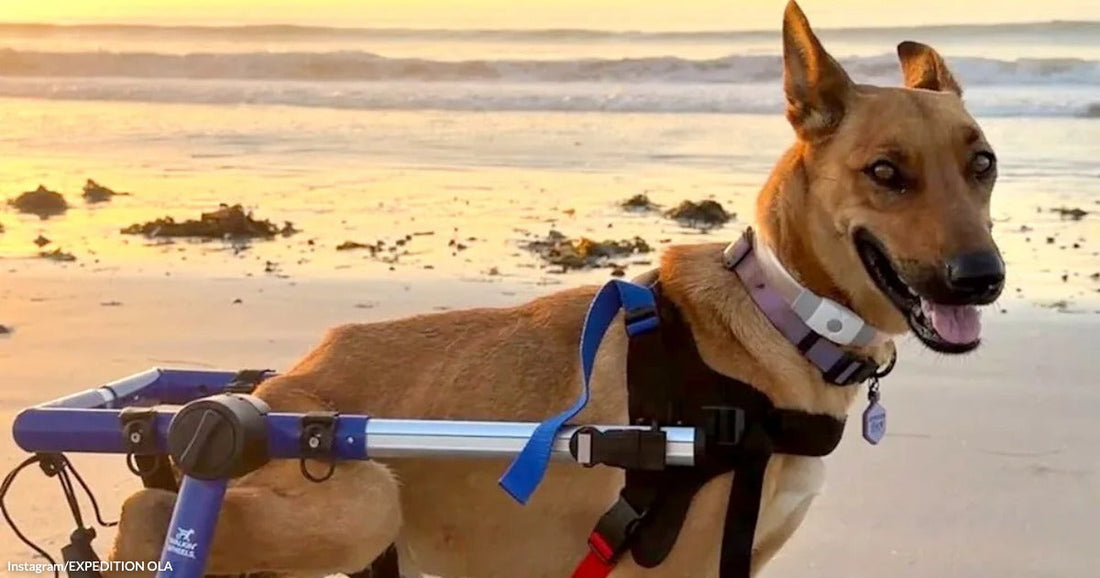
There is something uniquely moving about a rescue story where hope arrives when it is least expected. The journey of Birdie, a paralyzed stray dog rescued in Baja and now searching for her forever home, is one of those stories that quietly lodges in the heart. It is a story of a dog hit by a car and left to struggle, of strangers who refused to look away, and of the long road from trauma to healing that has since inspired millions of viewers who follow Birdie online.
According to dog rescuers and travelers Nick Reilly and Alli Jaeger, who share their work under the name Expedition Ola, Birdie first appeared in their lives while they were on vacation in Baja. They described seeing a dog “struggling to move” near their truck, a moment that shifted an ordinary day into something life-changing. Reilly and Jaeger wrote that they jumped out of their vehicle, and Birdie responded with trust, running toward them despite her obvious difficulty getting around.

Instagram/EXPEDITION OLA
Locals shared with the couple that Birdie had been crushed by a car about two months earlier. She had survived the initial impact, but the long-term consequences were devastating. A man in the area reportedly told them that Birdie had no one looking out for her and that they were welcome to take her and help in any way they could. From that point, Birdie’s life turned in a new direction.
Reilly and Jaeger later shared that when they first met Birdie, they did not fully understand the severity of her injuries. They took her to be examined and hoped to find a path to full recovery. After X-rays, the diagnosis was sobering. Birdie’s spine was completely severed, which meant she would never walk on all four legs again. For many animals in similar situations, this type of injury can be a crossroads moment that raises difficult questions about long-term quality of life.
The couple chose to focus on what Birdie could still have rather than what she had lost. They obtained a special wheelchair designed for paralyzed dogs and began the slow work of building her strength and confidence. At first, Birdie had to learn how to move with this unfamiliar set of wheels supporting her back legs. In time, she adapted.

One of the most striking moments in her story is captured in an Instagram video from Expedition Ola that has since gained more than eight million views. In the video, Birdie races across the beach in her wheelchair, ears flying and tail lifted as far as her body allows, wearing what her rescuers described as “the biggest smile.” That clip transformed her from an anonymous injured stray into a viral paralyzed dog whose zest for life resonated deeply with people around the world.
Even with the wheelchair, Birdie’s rescuers had to make serious medical decisions. They explained that although Birdie clearly loved life, the condition of her body left her vulnerable. Long-term complications, hygiene challenges, and the risk of ongoing injury can all be heightened for a dog who is paralyzed but still living with nonfunctional limbs. After weighing all options and consulting with veterinarians, Reilly and Jaeger decided that double amputation surgery was the best step to protect Birdie’s health and give her the greatest chance at a comfortable, active future.
The surgery itself was not the end of Birdie’s challenges. According to updates shared by Expedition Ola, Birdie experienced complications during the healing process and had to remain in the hospital longer than initially planned. Extended hospital stays can be stressful for any animal, especially one who has already experienced trauma and abandonment. Yet through those weeks, Birdie’s story continued to capture attention and support, as people followed each update and rooted for her recovery.
Eventually Birdie was cleared to leave the hospital and continue healing at home under the care of Reilly and Jaeger. They monitored her closely, taking particular care with her surgical incisions, especially around her tail. For a dog who once sped down the beach with effortless joy, the restricted activity and cautious rehabilitation represented another test of patience. Still, her caregivers appeared committed to prioritizing safety over speed as they guided her through this phase.
In late September, they shared what they described as a major milestone. Birdie was back in her wheelchair for the first time since her double amputation surgery. In their update, they said they had been deliberately hesitant to put her back into her wheels. They wanted to make sure there was no rubbing, scraping, or tension on her healing incisions. When they finally felt confident enough to try, Birdie’s expression seemed to say the rest. They wrote that judging by her face, she seemed very happy to be rolling again. That simple detail captures the heart of her story: an animal who keeps choosing joy whenever she is given the chance.
Throughout this journey, Birdie’s online presence has grown far beyond what anyone might have expected when she was first found on the side of the road. Millions have watched clips of her rehabilitation, from the early wobbly steps in her wheelchair to the triumphant zooms along the sand. Many viewers have responded not just to her physical recovery, but to the sense of resilience and gratitude that seems to shine through every time she is shown racing forward despite her limitations.
Reilly and Jaeger have emphasized how meaningful that support has been. Speaking to NBC News, Jaeger reflected on Birdie’s transformation, noting that this was once “one little street dog” who had been completely forgotten. To now see the world rally behind her is a powerful reversal. It highlights not only Birdie’s individual journey, but also the broader impact of compassionate rescue work and the way social media can amplify the stories of animals who might otherwise remain invisible.
Today, Birdie is still recovering and adapting to life after double amputation. Her wheelchair is again part of her daily routine, and her caretakers report that she is on the way to a full recovery. The next chapter in her story depends on finding the right permanent home. She is looking for a family able to embrace a special needs pet, to navigate her medical history with patience, and to celebrate her spirited personality rather than focus solely on her injuries.
I found it striking that what began as a chance encounter on a trip to Baja has become a global example of how far compassion can reach. Birdie’s transformation from injured stray to beloved viral paralyzed dog is not a simple feel-good story, because it includes medical risks, tough decisions, and many months of care. Yet it is hopeful in a grounded way. Her life today offers a reminder that animals with disabilities are still eager to play, explore, and bond, and that with the right support, they can thrive.
As Birdie rolls toward her future, somewhere out there is a person or family ready to welcome her and all that she represents: courage, resilience, and the joy of a second chance. For now, the world continues to follow along as she heals, flies down the beach in her wheels, and proves that a difficult past does not have to define the rest of a life.