
Giant Loggerhead Turtle Gets Cut Free At Sea After Fishermen Spot It Struggling In Ropes
Guest Contributor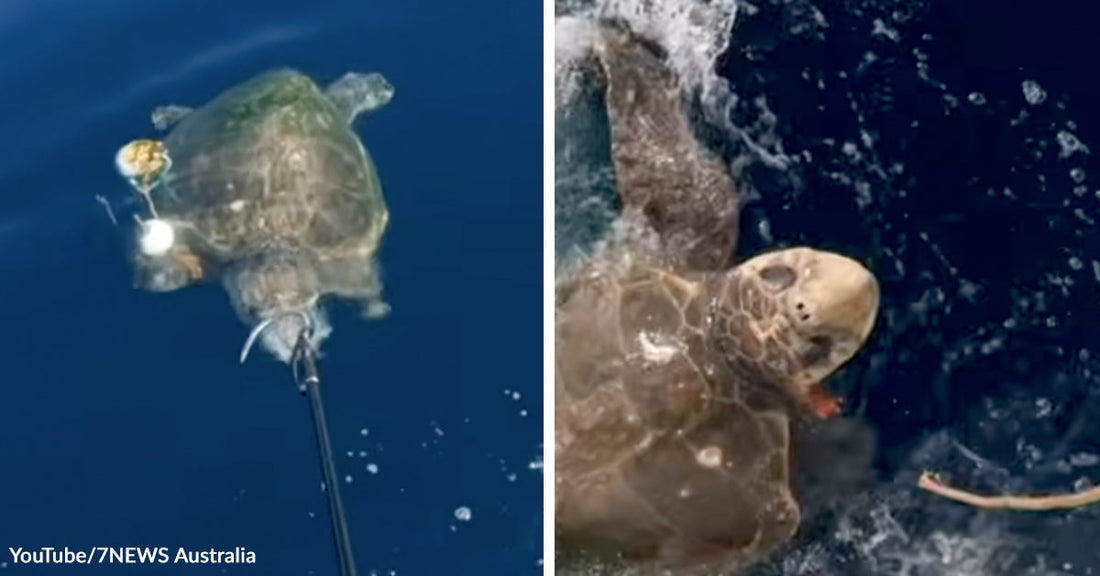
Off the coast of New South Wales, Australia, a routine day on the water turned into a life-or-death rescue for a massive loggerhead sea turtle. Fishermen spotted the 220-pound turtle struggling at the surface, wrapped several times in thick ropes tethered to barnacle-covered buoys. In a world where “ghost gear,” or abandoned fishing equipment, silently threatens marine life, scenes like this have become painfully common. Yet in this case, compassion, quick thinking, and a sharp knife made all the difference.
As the fishermen eased their boat alongside the exhausted loggerhead, one of them began carefully slicing away the heavy coils. Video from the rescue captures him speaking softly: “Stay still, lady,” he says as he works through the tight, tangled ropes. The turtle, weighed down and immobilized by the ghost gear, had likely been struggling for some time. When the last rope finally falls away and the turtle kicks free, the same fisherman breathes out, “What a mission!” The loggerhead sea turtle rescue ended with a simple, powerful image: a once-trapped animal disappearing back into the open ocean.

This is far from an isolated incident. Around the world, abandoned fishing gear drifts through the sea, nearly invisible until something gets caught. For sea turtles, which must surface to breathe and often migrate long distances, entanglement can be fatal. Ropes, nets, and crab pot lines can wrap around flippers, necks, or shells, restricting movement and making every breath a struggle. The article highlights how everyday people on the water can be the difference between tragedy and survival.
In June, in Virginia’s Chesapeake Bay, three fishermen encountered a similar scene, this time involving a much larger animal. They saw a 700-pound leatherback sea turtle fighting against the pull of crab pot buoy lines in choppy water. With winds at about 20 miles per hour and the turtle wrapped roughly ten times in lines around its neck and flippers, the conditions were challenging and potentially dangerous for both the rescuers and the turtle. Still, they decided to act.
One of the fishermen, Brandon Watts, maneuvered close enough to begin cutting the lines. He later told WAVY TV 10 that the turtle “seemed like he was crying for help,” and that a protective instinct took over. His description of his “dad mode” kicking in offers a glimpse into the emotional impact of seeing such a large, wild animal in obvious distress. Carefully working through the snarled lines, Watts and his friends kept at it until the last piece of rope fell away and the leatherback could finally move freely again. Once freed, the turtle swam away safely into the bay.
Watts’s friend, Travis Cullipher, reflected on how unusual the encounter felt, even for someone who had spent a lifetime on the water. He shared that he had been fishing since childhood yet had never seen a turtle in such distress. The experience left a mark on them both, and Watts summed up a central truth behind many of these rescues: the animals “didn’t ask for all that stuff to be in that water.” His comment underlines the human responsibility at the heart of the ghost gear problem and the potential for equally human solutions.
Another story from the article shows that meaningful action is not limited to seasoned anglers or large, dramatic rescues. In April, an 8-year-old girl visiting South Carolina with her family noticed a sea turtle hooked to Oak Island’s Ocean Crest Pier. Many people might have walked by or assumed someone else would handle it. Instead, her family reached out to the Oak Island Sea Turtle Protection Program, an all-volunteer nonprofit organization dedicated to protecting these vulnerable animals.
The turtle turned out to be a Kemp’s ridley sea turtle, considered the most endangered sea turtle species in the world. Volunteers from the protection program responded to the call, unhooked the turtle, and performed a careful assessment. They checked for tags, collected useful data for the state, and, after confirming the turtle was able to return to the wild, released him immediately. On Facebook, the organization publicly thanked Katie and her family for making the call that set the rescue in motion.
I found this detail particularly striking because it highlights how even a simple act, such as notifying the right people, can be critical for an endangered animal. The young girl did not need special training to help. She only needed to notice that something was wrong and to contact a group equipped to respond. That pattern appears across all three stories: ordinary people recognizing distress and choosing to intervene rather than look away.
Taken together, these rescues form a powerful narrative about sea turtles and human responsibility. The endangered sea turtle hooked on the pier, the immense leatherback entangled in crab pot lines, and the loggerhead strangled in ropes all faced potentially fatal encounters with human-made hazards. In each case, timely action prevented a likely tragedy. The events also underscore a broader truth about marine wildlife encounters: many threats are avoidable, and when they do occur, they are often reversible with quick, informed intervention.
The article emphasizes that anyone who spots a sea turtle that appears injured, trapped, or struggling should report it to local authorities or a marine conservation organization. Not everyone will be in a position to physically cut ropes or unhook gear, and in many situations, experts are better equipped to help. Still, making that call can be as significant as wielding the knife. Awareness of ghost gear and its dangers, along with the willingness to contact trained responders, can save lives throughout coastal regions.
Stories like these illustrate both the severity of the ghost gear problem and the remarkable difference that individual actions can make. They also invite readers to imagine how everyday choices on and near the water might prevent such entanglements from happening in the first place. Properly securing gear, reporting abandoned equipment, supporting clean-up efforts, and respecting local guidelines for wildlife all play a role in reducing risks for sea turtles and other marine animals.
At the heart of these accounts is a shared recognition that the oceans are not just a backdrop for human activity, but a home to vulnerable beings who often bear the consequences of human decisions. The fishermen off New South Wales, the crew in Chesapeake Bay, and an 8-year-old observer in South Carolina all responded to that reality with empathy and determination. Their actions allowed three sea turtles to return to the water, alive and unbound, and they offer a quiet blueprint for how others might respond when faced with similar moments. Read more at https://www.goodgoodgood.co/articles/sea-turtle-rescue-australia-strangled-ropes