
🚨Urgent: Missile Strikes Shelter in Ukraine! Rush Emergency Aid!
Family Finds Their 12-Year-Old Dog Injured And Then Learns She Protected Them From A Bear
Guest Contributor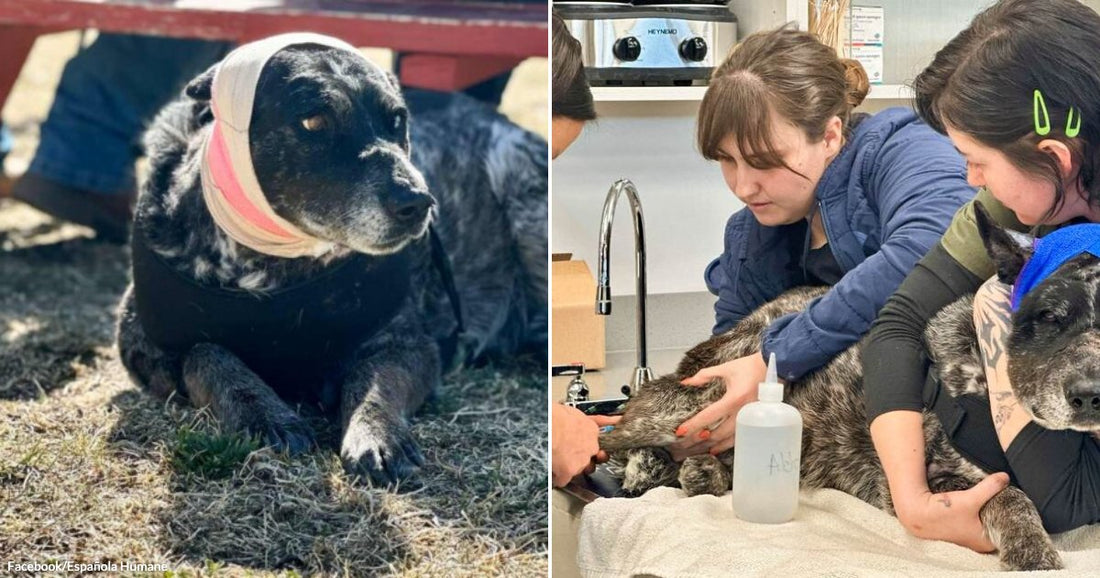
In a quiet rural corner of New Mexico, a half-blind senior dog named Honey recently showed the kind of courage that turns a local scare into an unforgettable story of loyalty and grit. This 12-year-old ranch dog, known to her family for being afraid of the vacuum cleaner, somehow found the resolve to confront a hungry bear and protect her home, her people, and the animals in her care. The tale of Honey the “Bearslayer” is already touching hearts, and it speaks powerfully to the bond between humans and animals, the fierce instinct to protect, and the resilience of an aging but determined dog.
The drama unfolded on the property of Denise Martinez, who keeps about 60 chickens in a coop along with horses and other dogs. It was a typical rural setting where wildlife and domestic life sometimes intersect, but nothing about what happened next felt ordinary. A bear, recently out of hibernation and described as famished, wandered onto the property. With the chickens clearly in danger and potentially the larger animals as well, the situation could have quickly turned tragic. Instead, it turned into a story of unlikely heroism.

Security camera audio captured the confrontation between Honey and the bear. Although full video details are not described in the original report, the sound alone was chilling. The audio recorded the chaos and violence of a senior dog taking on a much larger wild animal, fighting to fend it off from the coop and her family’s land. Honey had every reason to avoid a fight of that magnitude; she was already half-blind because of a previous encounter with a porcupine and far past the age most dogs are expected to act as physical protectors.
Yet, despite these disadvantages, Honey charged into action. The bear, newly awakened from its long winter sleep and seeking food, posed an immediate danger to the chickens and possibly to the horses and other dogs. The report makes clear that Honey appeared to understand this risk. According to Martinez, “She is our little savior, she’s always been protective that way.” Those words are made even more poignant by the severity of what Honey endured in order to live up to that protective nature.

Facebook/Española Humane
It was Denise’s daughter, Leanna, who ultimately found Honey after the fight. The dog had fallen under the weight of the bear’s attack and suffered extensive injuries. The reporting describes deep puncture wounds, severe bruising, and partial flaying around Honey’s head and neck. The family, hearing the terrifying sounds on the security recording and seeing the extent of Honey’s injuries, did not think she would survive. They rushed her to Española Humane, a local treatment center, believing they might only be buying her a bit more time, not a full recovery.
At Española Humane, Honey received intensive, life-saving care. The veterinary team performed surgery and began a regimen of medications and frequent bandage changes. The account notes that flaying, or the removal of skin, is distressingly common in bear attacks. The animal’s strength, along with its powerful tongue, is enough to remove the skin in large sections, as casually as a person might scoop away a bit of soft ice cream. Honey’s wounds reflected the brutality of that reality, and it is clear that the odds were stacked heavily against her.

Facebook/Española Humane
In this context, the fact that Honey pulled through feels remarkable. The staff at Española Humane highlighted not just the medical interventions, but the role of family and community support in her recovery. In a Facebook post celebrating the outcome, the organization wrote that thanks to her family’s love, a caring community, and “a little bit of … badassery,” Honey survived this ordeal. The affectionate nickname “Bearslayer” emerged as a way to honor her bravery without losing sight of her age and vulnerability.
I found this detail striking: Honey is described as a “half-blind sassy senior,” a phrase that captures both her physical limitations and her spirited personality. It is easy to picture her as an older ranch dog slowing down around the edges, perhaps spending more time resting than patrolling. Yet, when it mattered, she rose to the moment, fulfilling what the article calls the “ultimate responsibility of any ranch dog” to defend the homestead. Stories of dog courage are not new, but the image of a 12-year-old, vision-impaired animal taking on a bear feels especially powerful.
Once her condition stabilized and she was cleared to return home, Honey could finally rest in a place she knew well. The report emphasizes that she can now relax with the knowledge that she completed her duty without paying the ultimate price. That sense of completion, of a job done in the face of real danger, resonates with many people who live with working dogs, particularly those in ranching and rural environments. The bond is not simply about companionship; it is also about shared work and mutual trust.
From an emotional standpoint, Honey’s story carries a blend of fear, sorrow, and ultimately gratitude. Her family experienced what the reporting calls “heartbroken wonderment,” a phrase that captures the shock of almost losing her and the awe of realizing what she had done. They faced the possibility of a devastating loss and instead found themselves caring for a survivor whose actions likely prevented harm to many other animals, and possibly to people as well. In that sense, the rescue narrative is not just about medical success, but about a community recognizing the value of one small, determined dog.
There is also a broader reflection on the power and fragility of animals we often take for granted. Ranch dogs like Honey work quietly in the background, weaving themselves into daily routines and family rhythms. Their bravery is not usually tested against something as dramatic as a bear, yet Honey’s willingness to confront danger might represent, in a very visible way, what many such dogs would try to do instinctively. It is a reminder that courage does not always look like youth or physical perfection. Sometimes it looks like a senior dog with impaired vision refusing to back down.
For readers, Honey’s story may serve as a gentle invitation to appreciate the animals in their own lives, to recognize that even a dog who shies away from the sound of a vacuum cleaner might have a reservoir of quiet heroism. It also underscores the importance of organizations like Española Humane and the role of community support in turning near-tragedies into hopeful recoveries. Above all, Honey the Bearslayer stands as living proof that age and infirmity do not entirely define what any animal is capable of in a moment of crisis.