
🚨Urgent: Missile Strikes Shelter in Ukraine! Rush Emergency Aid!
Infrared Drone Searches the Darkness for a Dog and Owner In A Sinking Boat
Guest Contributor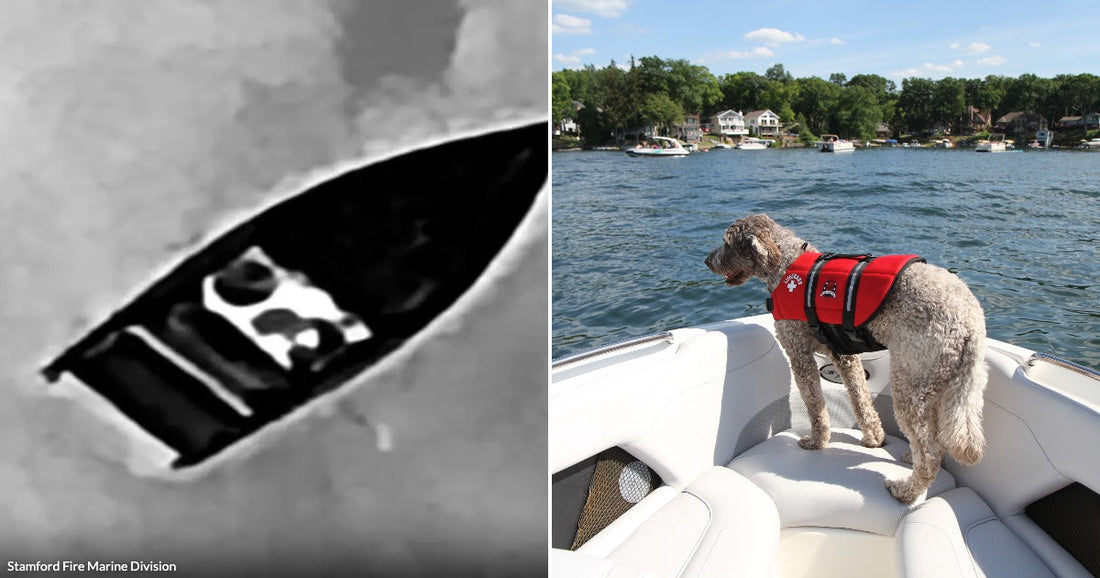
In the stillness of the early morning, a rescue operation unfolded off the Stamford coast that showed how traditional marine skills and modern technology can work together to save lives. According to city officials, firefighters pulled a person and their dog from a sinking 24-foot boat near Wescott Cove, safely bringing both to shore after the vessel began taking on water. The incident, which involved the Stamford Fire Department, the U.S. Coast Guard Sector Long Island Sound and the Stamford Emergency Communications Center, highlights just how critical coordinated response and tools like infrared drone imaging have become for coastal communities.
The situation began shortly before 1:30 a.m., when the U.S. Coast Guard contacted Stamford’s emergency dispatchers. The report described a vessel in distress that was actively taking on water in the dark waters off the city’s shoreline. A boat that size, already compromised, can deteriorate rapidly, especially at night when visibility is low and conditions are harder to assess.

In response, Stamford officials launched a full water rescue operation. They dispatched members of the Stamford Fire Department Dive team, emergency medical services personnel and multiple fire engines. Together, these responders formed a layered safety net designed to address everything from medical emergencies to underwater hazards. Although the account did not describe severe weather or rough seas, any rescue on the water in the early hours of the morning carries its own risks and challenges.
One of the most striking elements of this rescue was the role of technology. The Stamford Emergency Communications Center deployed a drone equipped with infrared imaging technology to help locate the distressed vessel. This use of an infrared drone search off Stamford’s coast offered rescuers an advantage that would have been nearly unimaginable just a few decades ago. Instead of relying solely on spotlights, radar or visual spotting from a moving boat, responders could scan the dark surface for heat signatures and other subtle indicators.

Stamford Fire Marine Division
Officials explained that emergency responders used radar to make contact with the vessel, then combined those readings with the drone’s infrared data to confirm the boat’s coordinates. This multi-pronged approach reduced the time spent searching and increased the precision of the response. Early identification can be the difference between a controlled rescue and a tragic outcome, especially when the vessel is already losing power and the engine compartment is underwater.
When firefighters reached the scene, they found one person aboard along with a dog. Authorities later reported that neither was injured, an outcome that is notable given the circumstances. The vessel’s engine compartment was submerged, which had caused the boat to lose all power. Without power, navigation becomes difficult or impossible, communication can be limited and bilge pumps or other onboard systems may fail. That combination can turn a minor mechanical issue into a serious emergency.

Stamford Fire Marine Division
In this case, emergency responders worked quickly to keep the vessel from slipping further beneath the water. Through dewatering operations using pumps aboard the fireboat, they were able to remove enough water from the 24-foot vessel to stabilize it. The description of those efforts shows how a relatively straightforward tool, a pump, can become the key element in preventing a boat from fully submerging. Once the immediate risk of sinking had passed, responders were able to arrange for the disabled boat to be towed back to Stamford’s harbor.
The successful rescue of the person and the dog from the sinking boat near Wescott Cove underscores the value of preparation and layered response. Marine incidents rarely unfold in a predictable way, yet this operation followed a clear and coordinated pattern. The Coast Guard relayed the emergency to local authorities. The Stamford Emergency Communications Center then combined radar, infrared imaging and traditional dispatch to guide fire and rescue crews to the right spot on the water with minimal delay.
I found this detail striking because it shows the growing importance of integrating technology into emergency operations without losing sight of the human skills involved. Drone-based infrared imaging, radar and marine navigation tools all supported what ultimately remained a very hands-on rescue. Firefighters still had to reach the vessel, assess the damage, reassure the person aboard and handle a frightened pet while also managing pumps and monitoring water levels in an unstable boat.
This incident also quietly highlights the emotional dimension of such rescues. For many people, a dog is a family member, and knowing that responders made sure the animal was brought to safety alongside its guardian adds depth to the story. Marine responders are trained to prioritize human life, yet they often go to significant lengths to safeguard animals too. While the report focuses mainly on the technical and logistical aspects, the calm removal of both person and dog from a precarious situation reflects a compassionate approach.
From a broader perspective, the Stamford boat rescue offers a practical example of how coastal cities are adapting to changing expectations and technologies in public safety. Infrared drones are becoming more common tools for search and rescue near the shoreline, particularly in areas with heavy recreational boating or complex coastal geography. The ability to quickly pinpoint a location in the dark or through haze can greatly increase the chances of a positive outcome, especially for smaller vessels that may not have advanced communications or tracking systems.
For residents and boaters in and around Stamford’s harbor, this story may also serve as a reminder of the importance of safety on the water. While the report does not detail what caused the boat to take on water, the scenario reinforces how rapidly a seemingly manageable problem can evolve when a vessel loses power and begins to flood. It also highlights why communicating quickly with the Coast Guard and local emergency services is so critical when something goes wrong offshore.
Ultimately, the rescue near Wescott Cove stands as an example of effective cooperation between federal and local agencies as well as between personnel on land, in the air and on the water. The Coast Guard’s initial alert, the Stamford Emergency Communications Center’s coordination, the drone’s infrared data and the fire department’s on-water response all converged on a single goal: bringing a person and their dog safely home. In an age defined by advanced tools and constant information, stories like this one show how technology and human judgment can reinforce each other when lives and livelihoods hang in the balance.