
Strait of Hormuz Oil Slicks Devastate Fragile Gulf Ecosystems
Guest Contributor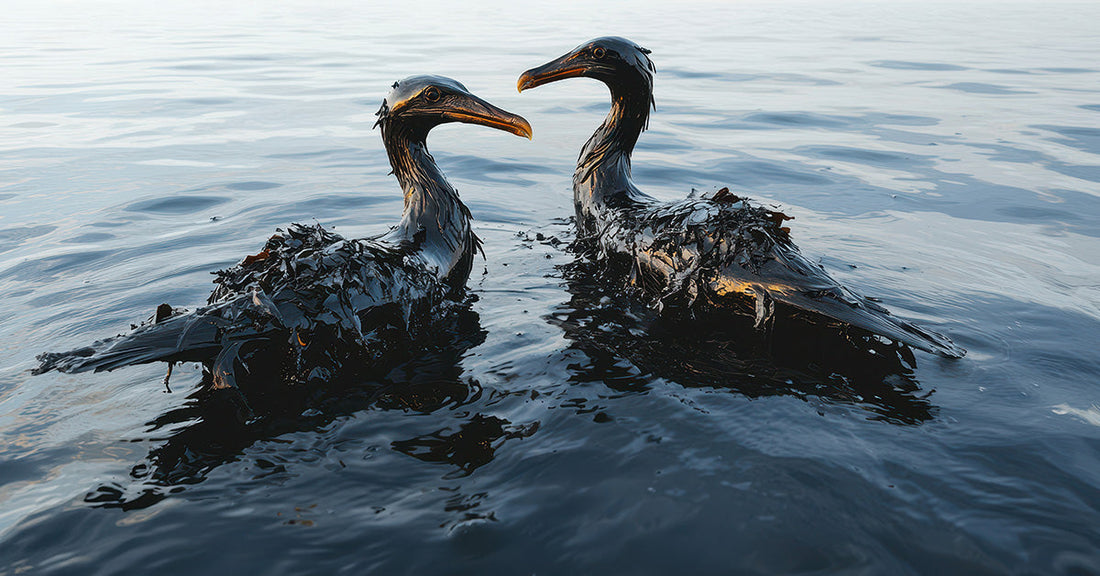
From space, the oil slicks in the Strait of Hormuz appear as vast, dark scars across bright blue water. They are not natural patterns or tricks of light. They are the visible imprint of a war that has turned one of the world’s busiest oil shipping routes into both a battlefield and the center of a growing environmental disaster. At the heart of this crisis is a fragile Gulf ecosystem under pressure from missile and mine attacks on oil tankers, repeated spills and an already warming sea.
The Strait of Hormuz is the only maritime passage between the Gulf and the Arabian Sea, and environmental experts have long described it as rich but vulnerable. Coral reefs, mangrove forests and seagrass meadows fill these shallow waters. They support dolphins, sea turtles and countless species of fish. The strait also plays a crucial role in circulating water and nutrients and acts as a migration route for marine mammals. Even in peacetime, this narrow waterway has faced intense strain from heavy shipping traffic, oil extraction and constant coastal development.

Oil pollution adds a deadly new layer of stress. Crude on the surface can coat seabirds’ feathers, stripping away their insulation and making it difficult for them to float, fly or find food. Along the shore, slicks can cling to mangrove roots and block oxygen exchange, which risks killing the trees that anchor entire coastal food webs. Marine biologist Bernhard Riegl, who has studied the Gulf for more than three decades, points out that this region is especially exposed to the climate crisis. The Gulf is shallow, and in summer the air is hot and often still. Heat passes quickly into the water, there is little mixing with cooler deep layers and corals, algae and fish can die when temperatures spike. Adding oil pollution to this already fragile system significantly increases the risk of lasting damage.
Since the war between the United States and Iran began on 28 February, the Strait of Hormuz and surrounding waters have experienced an alarming number of oil spills. Greenpeace has used satellite monitoring to identify more than 500 spill events across the Gulf, the strait and the Arabian Sea. Some are directly linked to attacks on tankers. Others appeared around the time of reported strikes, although their exact causes remain unclear. When Greenpeace analysts combined the daily mapped footprints of these slicks, they found that the cumulative area reached roughly 20,000 square kilometers, which they note is almost the size of Wales.
The scale of the attacks driving this pollution is stark. Environmental monitors report that more than 133 oil tankers have been attacked since the conflict began, with October standing out as the worst month so far. That month saw more than 30 confirmed or reported assaults in the Strait of Hormuz and nearby waters. The attacks have continued into November and many have left long, drifting slicks behind the damaged ships.
One of the most polluting strikes in October hit the supertanker Gem No 2 off the coast of the United Arab Emirates. A satellite image dated 19 October captured a long, black ribbon of oil, more than 35 kilometers in length, moving into the clear waters off Umm Al Quwain. Greenpeace estimates that an earlier attack in June led to a slick off the coast of Oman that spread over more than 600 square kilometers at its peak. According to environmental researcher Wim Zwijnenburg, two Iranian naval vessels struck in March continued leaking for months, feeding fresh oil into already contaminated waters.
Other incidents tell a similar story. An attack on the Liberian flagged Minoan Pioneer on 3 August has been associated with yet another large slick. In March, oil from the struck Shahid Bagheri was detected near the Hara mangroves, a precious coastal habitat. In April, pollution threatened Shidvar Island, a protected area known for coral reefs, seabirds and turtle nesting sites. By August, oil was reported washing ashore around Qeshm Island, close to important fishing grounds and beaches where sea turtles come to lay eggs.

Satellite imagery has also captured slicks near Oman’s Musandam national park and Iran’s Minab River delta. Both regions are biodiversity hotspots. Musandam contains coral reefs and breeding sites for seabirds. The Minab delta hosts protected mudflats and extensive mangrove forests. Environmental organizations continue to study satellite data to map the spread of contamination, yet they stress that they cannot fully assess the damage without on the ground investigations. Those remain extremely difficult, partly because of naval blockades and partly because some scientists and environmentalists in the region report that they have been instructed not to speak publicly about the war’s environmental costs.
Responsibility for specific attacks is complex. The article attributes most of the strikes to Iran’s Islamic Revolutionary Guard Corps, while also noting that United States forces have targeted tankers. Some Iranian vessels have reportedly been disabled as they tried to breach a US naval blockade, and others were hit following missile attacks on US warships. A report cited from the Wall Street Journal links the largest single spill to an airstrike carried out by the United Arab Emirates on oil storage tanks on Lavan Island, an incident that sent crude pouring into the Gulf and affected nearby coastal areas, including nature reserves around Shidvar Island. The shared outcome of these actions is widespread pollution in a semi enclosed sea that has limited capacity to absorb shock.
Coastal states have responded in some cases. After the Gem No 2 attack, authorities in the UAE closed beaches, launched large cleanup efforts and closely monitored desalination plants that supply freshwater. By 30 October, officials said the leak had been stopped and that visible pollution was declining. Oman deployed divers and specialized equipment to a damaged vessel and organized shoreline cleanup along seven miles of coast near the Hallaniyat Islands. These emergency measures can limit the immediate impact on beaches and infrastructure, yet they address only the most obvious layer of the crisis.
Experts warn that the deeper environmental damage is likely to persist long after the surface slicks fade from view. Oil can become trapped in sediments, along shorelines and among mangrove roots. There it can continue to harm marine food chains, fishing communities and coastal ecosystems for years. Nina Noelle of Greenpeace notes that contamination affects a wide range of organisms. Small invertebrates, fish, birds and turtles can all suffer from exposure. Mangroves and coral reefs are particularly slow to recover, especially when oil lingers in the substrate or when repeated spills cause new pulses of pollution before earlier damage has healed.
Past conflicts in the region provide a sobering preview of what may lie ahead. The aftermath of the Iran Iraq war and the first Gulf War showed that large scale oil pollution in the Gulf can leave a legacy that lasts decades. A 2020 study found widespread deposits of tar on Qatari beaches and traced them back to the Gulf War. Another study published in 2022 identified sediments on Saudi Arabia’s Abu Ali Island that were still contaminated by oil from the Nowruz spills of 1983 to 1985, which together leaked about 80 million gallons of crude into the sea.
Riegl points out that any organism that digs into beaches affected by these spills can be exposed to buried contaminants. Nesting sea turtles encounter polluted layers when they lay their eggs. Burrowing creatures such as ghost crabs continually bring contaminated sediment back to the surface. These are not impacts that disappear with a single cleanup operation. They remain measurable for generations and threaten what he describes as something irreplaceable in the Gulf’s unique marine environment. I found this detail especially striking, because it highlights how easily the long memory of the sea can be overlooked when conflicts are framed only in immediate human terms.
The picture that emerges from the satellite data, expert testimony and historical parallels is stark. There is, as Riegl notes, no such thing as a “clean war,” either for the people who live through it or for the environment that absorbs its hidden costs. In the Strait of Hormuz, the price is being paid by corals, mangroves, fisheries and coastal communities whose livelihoods depend on a living, functioning sea. The oil slicks seen from space are a reminder that the consequences of today’s decisions will remain visible on these shores for decades to come. Read more at https://www.theguardian.com/world/2026/nov/12/oil-slicks-seen-from-space-the-devastating-impact-of-boat-strikes-on-fragile-gulf-ecosystems