🚨Urgent: Missile Strikes Shelter in Ukraine! Rush Emergency Aid!
The Navajo Code Talkers Legacy Secured Victory with Indigenous Language
Guest Contributor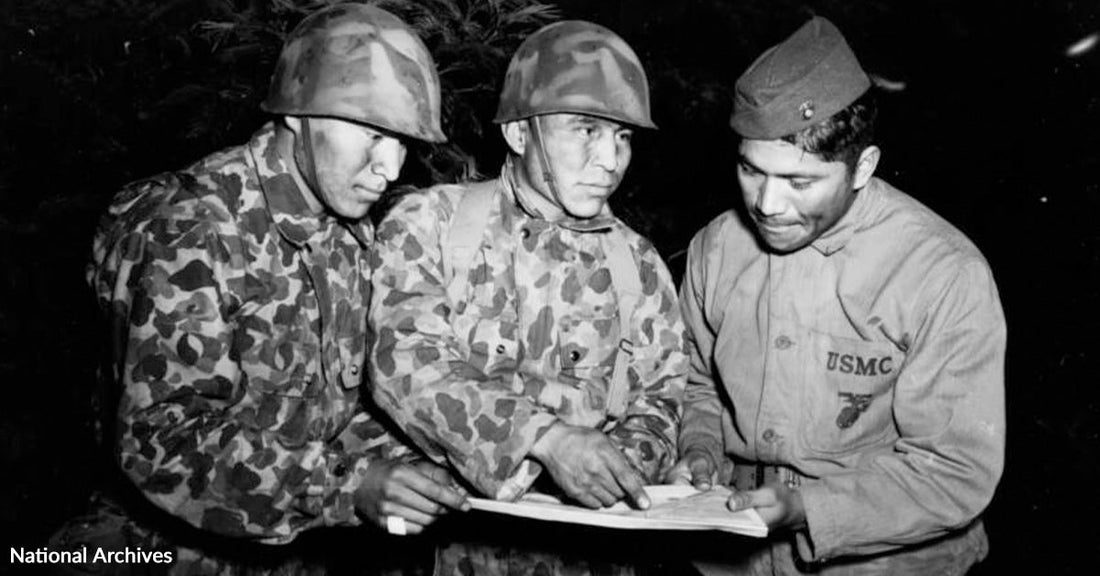
During World War II, the United States faced a critical challenge in maintaining secure military communications. Japanese forces were increasingly adept at cracking Allied codes, threatening the safety and success of operations in the Pacific Theater. In response, the U.S. Marine Corps turned to an unlikely but ultimately invaluable solution: the Navajo language. The story of the Navajo Code Talkers is a remarkable example of how cultural heritage and linguistic complexity helped the Allies secure victory in one of history’s most devastating conflicts.

In 1942, the Marine Corps recruited 29 Navajo men to develop a code based on their native language. This group would become known as the original Navajo Code Talkers. The decision was inspired by Philip Johnston, a civil engineer and World War I veteran who had grown up on a Navajo reservation. Fluent in the language, Johnston understood its intricacies and recognized its potential as a secure communication tool. When he proposed the idea to military officials, they agreed to a trial—and the results were extraordinary.

The Navajo language is highly complex, with no written alphabet until the mid-20th century and a structure unfamiliar to most outside the Navajo Nation. This made it nearly impossible for enemy forces to understand. The original recruits devised a code that assigned Navajo words to military terms, often using metaphors from nature. For example, different types of aircraft were named after birds, such as the buzzard for a bomber or the hummingbird for a fighter plane. They also created an alphabet system using Navajo words, where the word for ant, “wo-la-chee,” stood for the letter “A.”
What made the Navajo code so effective was its simplicity and speed. Unlike traditional codes that required lengthy encryption and decryption processes, this system relied solely on verbal communication. During initial tests, messages were encoded, transmitted, and decoded in under three minutes—an unprecedented speed that impressed Marine Corps leadership. The code was not only fast but also unbreakable. Even someone fluent in Navajo would find it indecipherable without knowing the specific code vocabulary, as the terms were selected arbitrarily.
As the war progressed, the number of Navajo Code Talkers grew to over 450. Their contributions were critical in battles across the Pacific, particularly during the Battle of Iwo Jima. For two consecutive days, six Code Talkers transmitted more than 800 messages without a single error. Major Howard Connor, the signal officer at the time, later stated that the Marines could not have taken Iwo Jima without the Navajos. Their flawless communication under pressure saved countless lives and ensured the success of key military operations.
Despite their extraordinary service, the Navajo Code Talkers remained unrecognized for decades. After the war, they were ordered to keep their role secret in case the code needed to be used again. Not even their families knew the extent of their contributions. It wasn’t until 1968 that the operation was declassified, allowing the Code Talkers to finally speak about their work. Official recognition came slowly. In 1982, President Ronald Reagan declared August 14 as Navajo Code Talkers Day. Then, in 2000, President Bill Clinton awarded the Congressional Gold Medal to the original 29 Code Talkers. By the time the medals were presented the following year, only four of the original group were still alive.
What I found particularly striking is the irony at the heart of this story. Many of the Navajo men who served were recruited from schools that had attempted to suppress their language and culture. These institutions aimed to assimilate Indigenous youth by discouraging the use of their native tongue. Yet, it was precisely this language—once viewed as a barrier to integration—that became one of the Allies’ most powerful tools in defeating the Axis powers. The same words that had been forbidden in classrooms were now saving lives on the battlefield.
Today, the legacy of the Navajo Code Talkers is a powerful reminder of the strength found in cultural diversity. Their story is not just one of military strategy but also of resilience and recognition. It highlights how Indigenous knowledge and identity, long marginalized, played a pivotal role in shaping global history. The Navajo Code Talkers turned their ancestral language into an unbreakable code, proving that sometimes, the most effective solutions come from the most unexpected places.