
🚨Urgent: Missile Strikes Shelter in Ukraine! Rush Emergency Aid!
The Wright Brothers Legacy and the First Powered Airplane Flight
Guest Contributor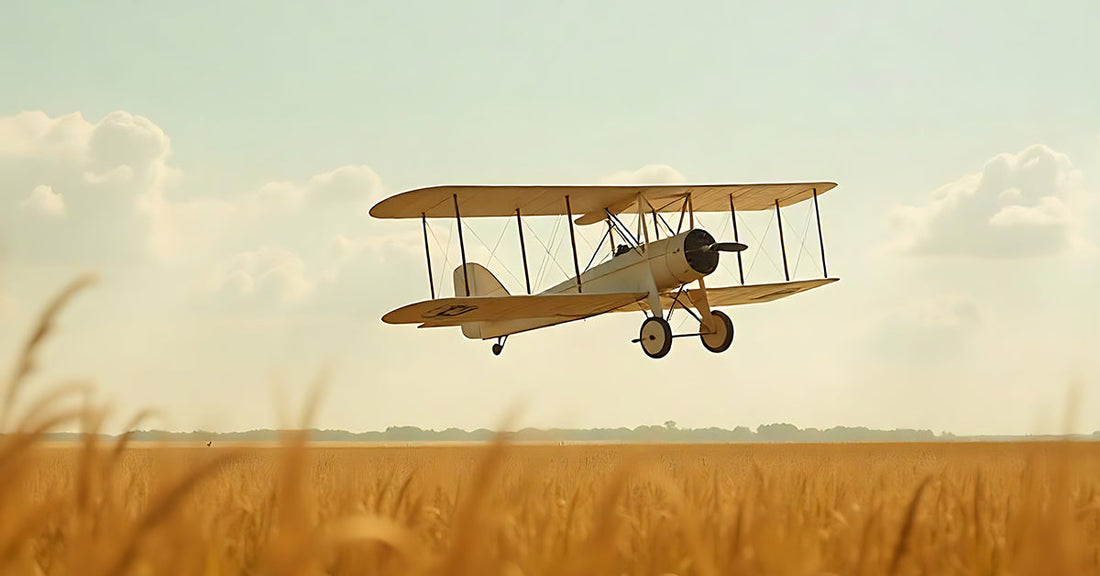
In the closing days of the 19th century, a wave of innovation swept through the world, bringing with it a fierce determination to conquer the skies. Among the many inventors who dreamed of flight, two brothers from Dayton, Ohio—Orville and Wilbur Wright—would ultimately succeed where others failed. Their story is one of curiosity, persistence, and groundbreaking ingenuity. With the first successful powered and controlled airplane flight in 1903, the Wright brothers changed the future of transportation and ushered in the modern age of aviation.

The Wright brothers' passion for flight began in childhood. In 1878, their father brought home a rubber band-powered toy helicopter that sparked their fascination with flight mechanics. This early exposure, combined with encouragement from their parents to explore intellectual pursuits, laid the foundation for their later achievements. Despite their talents, neither brother attended college. Wilbur was set to go to Yale but withdrew after a hockey injury, while Orville dropped out of high school to start a printing business. Their nontraditional paths highlight how self-directed learning and hands-on experimentation drove their success.
By the early 1890s, the Wrights had shifted from printing to bicycles, opening the Wright Cycle Co. in Dayton. Their work designing and building bicycles honed their mechanical skills and deepened their understanding of balance and control—skills that would prove invaluable in their aviation experiments. As interest in flight grew globally, the brothers followed the work of pioneers like Otto Lilienthal, a German aviator whose gliding experiments demonstrated that heavier-than-air flight might be possible. Lilienthal’s tragic death in 1896 only strengthened the Wrights’ resolve to tackle what they called "the flying problem."
They began their own experiments in 1899, starting with a small biplane kite. Realizing they needed better conditions for testing, they traveled to Kitty Hawk, North Carolina, where steady winds and soft sands provided an ideal environment. Their early gliders did not perform as expected, but each failure brought new data. By 1901, they had built a wind tunnel to test over 200 wing designs, eventually discovering that longer, narrower wings produced better lift. They also corrected a key error in the Smeaton coefficient, a widely used constant in lift calculations, which had previously led to flawed designs.
In 1902, the Wrights returned to Kitty Hawk with a new glider featuring a 32-foot wingspan and a movable rudder linked to their wing-warping system. This allowed for coordinated turns and greatly improved control. Over 1,000 successful flights proved that they had solved the fundamental challenges of controlled flight. Confident in their design, the brothers turned their attention to building a powered aircraft.
With no suitable engines available, they collaborated with their bicycle shop mechanic, Charlie Taylor, to build a custom 12-horsepower engine weighing about 180 pounds. They also designed efficient, counter-rotating propellers. The result was the Wright Flyer, a biplane with a 40.3-foot wingspan and a forward elevator. On December 17, 1903, Orville Wright piloted the Flyer for 12 seconds, covering 120 feet. Wilbur followed with a flight of 852 feet in 59 seconds. These were the first controlled, sustained flights of a powered, heavier-than-air aircraft—witnessed by five local residents and documented in history.
The brothers continued refining their designs. The Wright Flyer II and III addressed stability and control issues, with the Flyer III achieving a record flight of 24 miles in 38 minutes in 1905. Realizing the importance of protecting their invention, they paused public flights to secure patents. By 1908, they had contracts with the U.S. Army and French investors, and began public demonstrations that included carrying passengers. The Wright Company and Wright Exhibition Company soon followed, allowing them to train pilots and manage aircraft production.
Tragically, Wilbur Wright died of typhoid fever in 1912 at the age of 45. Orville continued their work, later serving on the National Advisory Committee for Aeronautics, the forerunner of NASA. He witnessed the rapid evolution of aviation through both world wars before passing away in 1948. I found it striking that the same man who once built bicycles in a small Ohio shop lived to see jet engines and the early space age take shape.
Today, the Wright brothers’ legacy endures not just in museums or textbooks, but in every commercial flight, space launch, and drone hovering overhead. Their story reminds us that progress often begins with a simple question and the courage to pursue its answer through trial and error. From a toy helicopter to the skies over Kitty Hawk, their journey remains one of the most inspiring chapters in the history of innovation.