
Workers Think Dog Is Dead Until Something Moves Beside the Tracks
Guest Contributor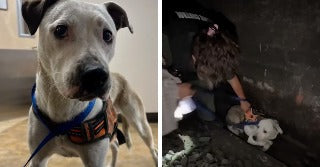
In San Francisco, a heartwarming rescue story unfolded underground, far from the city’s famous hills and sweeping views. A two-year-old pitbull named Roo survived two days inside a dim railway tunnel before being guided safely back into the light. For anyone who follows animal rescue stories or cares about dog safety, Roo’s adventure is both a cautionary tale and a testament to persistence, compassion, and a bit of luck. It also highlights the quiet heroism of animal control officers and transit workers who encounter these emergencies where most people never look.
According to a social media post from San Francisco Animal Care & Control, Roo had recently been adopted when he ran away after being “spooked.” The details of what frightened him are not given, but the result was dramatic. Instead of wandering through neighborhoods or parks, Roo ended up in a Caltrain railway tunnel, a place that is hazardous for any living being, especially a confused young dog without a clear path out. The darkness, the noise of trains, and the confined space would be overwhelming for most animals, and Roo was no exception.

On the first day he was in the tunnel, Caltrain operators spotted Roo along the tracks. From the train, his body appeared motionless. Staff feared the worst and believed he had been struck and killed. In the industrial landscape of tracks and tunnels, where trains have schedules to keep and visibility is limited, these workers could easily have dismissed what they saw as a tragic accident. Instead, their observation set the stage for a very different outcome. As the San Francisco shelter later described, those initial moments were filled with concern rather than certainty.
The next day brought a surprise. Roo was seen moving. That simple sign of life changed everything. Once it was clear that the dog was still alive somewhere in the railway tunnel, animal control officers responded on foot. There is no suggestion that this was an easy task. They entered a space designed for trains, not people, equipped only with a flashlight and the resolve to find a frightened animal. The environment would have been loud, disorienting, and inherently risky, with narrow passages and the constant potential for passing trains. Going in on foot meant committing to a search with no guarantee of how Roo would react when found.

San Francisco Department of Animal Care & Control
Eventually, the officers located Roo curled up next to the rail track, deep in the darkness. According to the shelter’s account, he was terrified at first. This reaction is easy to imagine. A young pitbull, recently separated from a new home, had spent two days in a tunnel with unfamiliar sounds and no clear escape. It is not hard to picture the tension as the officers approached, balancing the need to move quickly with the need to avoid startling him again. Yet the moment did not end in panic. Once Roo understood he was being helped, his behavior shifted from fear to relief.
The shelter described how he went from being “terrified at first” to “thrilled to be rescued.” That contrast carries a lot of emotional weight. It suggests a transformation from helplessness to trust in a very short timeframe. The officers led Roo out of the tunnel and back into daylight, a simple act that symbolized his return to safety and to the life he was meant to have outside that confined space. In many animal rescue stories, there is a small turning point when fear gives way to connection, and this appears to have been Roo’s.

San Francisco Department of Animal Care & Control
One detail that stands out in this story is that Roo was microchipped. Because of that single precaution, the shelter and animal control team were able to identify his owner and arrange a reunion. Roo’s story might have been very different if he had no permanent identification. Instead of a quick return, he could have entered the system as an unclaimed stray, with no easy way to match him to the home he had just begun to know. Microchipping is widely recommended as a basic safety step, and this case offers a clear, real-world example of why. Once Roo was safe, the chip helped ensure he did not remain simply “the pitbull from the railway tunnel” but went back to being a cherished companion.
The San Francisco area has seen other notable moments of community response to dogs in distress. Recently, Menlo Park firefighters rescued a missing dog found swimming in the San Francisco Bay, with seagulls following as the dog struggled in open water. The image is striking: emergency responders and a vulnerable animal surrounded by waves and wildlife. That incident, like Roo’s ordeal underground, illustrates how public services like fire departments, animal control, and transit personnel often intersect when an animal is in danger. Their roles may differ day to day, yet when a call comes about a dog in trouble, they frequently work in tandem to bring that animal to safety.
Stories like Roo’s resonate because they blend everyday infrastructure with unexpected compassion. A railway tunnel is usually connected to timetables, commuters, and steel tracks. It is not a place we associate with a frightened pet, let alone a delicate rescue. Similarly, a busy bay is more commonly pictured with cargo ships, kayakers, and seabirds than a dog trying desperately to stay afloat. When people step into these environments to save an animal, it disrupts expectations in a meaningful way. It shows that even in heavily engineered spaces meant for trains and boats, there is room for empathy.
There is also a broader reminder about the responsibilities that come with adopting animals, including those like pitbulls that sometimes face misunderstanding in public perception. Roo’s escape appears to have been an accident triggered by fear, which can happen with any dog. The key factors in his positive outcome were attentive transit staff, a rapid response from animal control, and the foresight to have him microchipped in the first place. For many readers, particularly dog guardians, these details may reinforce the value of secure environments, proper identification, and prompt communication with local shelters if a pet goes missing.
I found it striking how a brief social media post from an animal shelter can open a window into the complex web of people and systems that converge in a single rescue. Caltrain operators, animal control officers, shelter staff, and a relieved pet owner each played a part in turning what could have been a quiet tragedy into a story of survival and reunion. Roo’s two days in a dark railway tunnel ended not with loss, but with a walk back into daylight and a return to the life he nearly lost. For those who care about animal welfare, it is a reminder that even in the busiest urban settings, attention, preparation, and coordinated action can transform fear into relief.