
💜 Thanksgiving Food Drive for Shelter Pets Help Us Feed 1 Million Shelter Pets!
Willie Nelson's 700-Acre Sanctuary for Over 70 Horses Rescued from Slaughter
Guest Contributor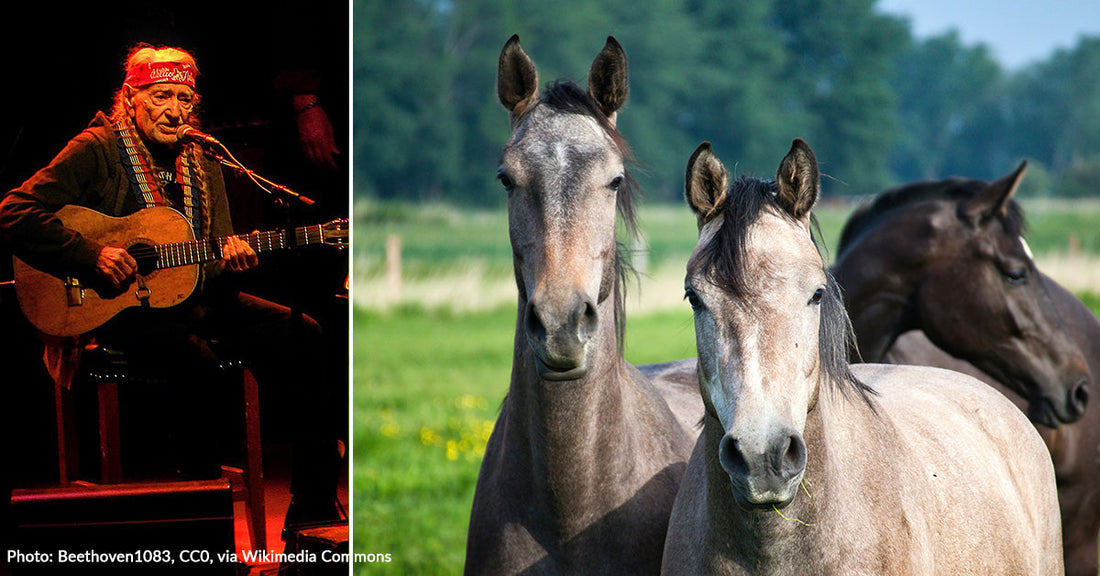
In the hills of central Texas, there is a place where an old movie set turned into something quietly extraordinary. What started as a backdrop for Willie Nelson’s 1980s film “Red Headed Stranger” has become Luck, Texas, a 700-acre ranch that is home to more than 70 rescued horses. Instead of being known for luxury amenities or celebrity glitz, this ranch is known for life, space, and second chances. At a time when many celebrity homes are defined by their pools or their price tags, Willie Nelson’s ranch stands out for a different reason entirely.
The story begins with a western town that was never meant to last. Built as a film set for “Red Headed Stranger,” the faux-fronted main street and rustic buildings were originally just scenery. When the cameras stopped rolling, however, the set stayed. Over the years it evolved from a temporary backdrop into a real place with its own identity, complete with a music venue and a name: Luck, Texas. The name inspired one of Nelson’s favorite lines about the property, a playful reminder that when visitors are there, they are “in Luck,” and when they leave, they are “out of Luck.”
What truly transformed Luck, Texas from an interesting curiosity into something remarkable was not the film history or the on-site venue, but the herd that began to roam its pastures. According to interviews Willie Nelson gave and coverage shared by HELLO! magazine, more than 70 horses now live on the ranch. Most of them were “ready to go to slaughter” before Nelson stepped in and gave them a different future. They arrived not as working animals or performers, but simply as beings who needed a safe place to exist.
These horses do not pull wagons for tourists, appear in shows, or race for prizes. They simply live. Nelson has described them as “the luckiest horses in the world,” and with good reason. Instead of facing a grim end, they now roam 700 acres of Texas Hill Country, grazing on open land and receiving individual care. As he has proudly pointed out, they are hand-fed twice a day, a small but telling detail that hints at the daily attention behind the poetic image of horses running free across a wide landscape.
That image has captured public attention more than once. The story of Willie Nelson’s horse rescue efforts resurfaced in a major way in November 2026 when People magazine revisited how the 93-year-old singer had transformed his old movie set into a sanctuary-style ranch. Readers shared it widely, moved by the idea of a man in his nineties still building, tending, and protecting rather than slowing down. Instead of a quiet retirement, the picture that emerges is of a life still full of motion, responsibility, and care.
There is something quietly resonant in the contrast at the heart of this story. On one side, an aging film set built for a specific project that could have easily been torn down or left to rot. On the other, a group of animals who were at the end of the line, “ready to go to slaughter” with no expectations of a future. Both the town and the horses were the kind of things the world often moves past and forgets. At Luck, Texas, they intersected, and instead of disappearing, they were given another role to play.
The appeal for animal lovers is obvious. Many people are drawn to stories of rescued creatures getting a second chance, whether it is a dog finding a new home or, as referenced in related pieces, a cat who escaped a shelter to reunite with the person who once cared for him. There is also the surprising gentleness in stories like the photographer who woke up next to a sleeping cheetah. They all offer a version of the same theme: lives that were at risk or in limbo finding safety in unexpected ways.
What sets the narrative of Luck, Texas apart is the scale and the setting. A western town built for a movie now anchors a very real sanctuary, and the expanse of a 700-acre ranch turns the idea of rescue from a single gesture into a fully lived reality. The horses do not just survive. They live out their days in a space large enough to feel, in human terms, like a whole small world. The ranch’s music venue opens only for specific events, which reinforces the sense that daily life there is not about public display. Instead, the property functions as a private refuge where the main audience is the herd itself.
From a cultural perspective, Willie Nelson’s horse rescue ranch also illustrates a different kind of celebrity influence. Many famous figures are known for conspicuous consumption, and their properties often make headlines for size, design, or extravagance. Here, the point of interest is something quieter. The fake main street may draw some initial curiosity, but it is the real horses and their very practical needs that define the place. Rather than being curated purely for visitors, the land has been shaped around the comfort and security of the animals that live on it.
The story also acknowledges its own limits. The number of horses on the ranch is usually described as “over 70,” based on interviews from 2019 and an October 2026 report from HELLO! magazine, with the understanding that the exact count can change over time. The property is private, the events selective, and there is no ongoing public tally of each animal that comes or goes. What is clear is the intent: to turn a space that might have faded into obscurity into an active place of care.
I found this detail striking because it reframes what it means to age in public. At 93, as reported when the story recirculated, Nelson was not just maintaining a legacy through archives or commemorative events. He was actively sustaining a community of living beings, tending to them day after day. The story of Luck, Texas is not only about the charm of an old movie set or the novelty of a private western town. It is about a long, evolving commitment to giving vulnerable animals another chance and about how an artist who once used the land as a backdrop for fiction later turned it into a stage for compassion.
In a world full of costly renovations and headline-grabbing estates, it is quietly powerful that one of the most compelling celebrity properties is defined by a herd that does not perform and a town that was never meant to be real. Luck, Texas, with its rescued horses and hand-fed mornings, offers a reminder that sometimes the most meaningful transformations happen when something built for show becomes, over time, a genuine home.