
🚨Urgent: Missile Strikes Shelter in Ukraine! Rush Emergency Aid!
Squirrel Living in Wall Inspires An Urban Wildlife Solution, And A Window To It's Little World
Guest Contributor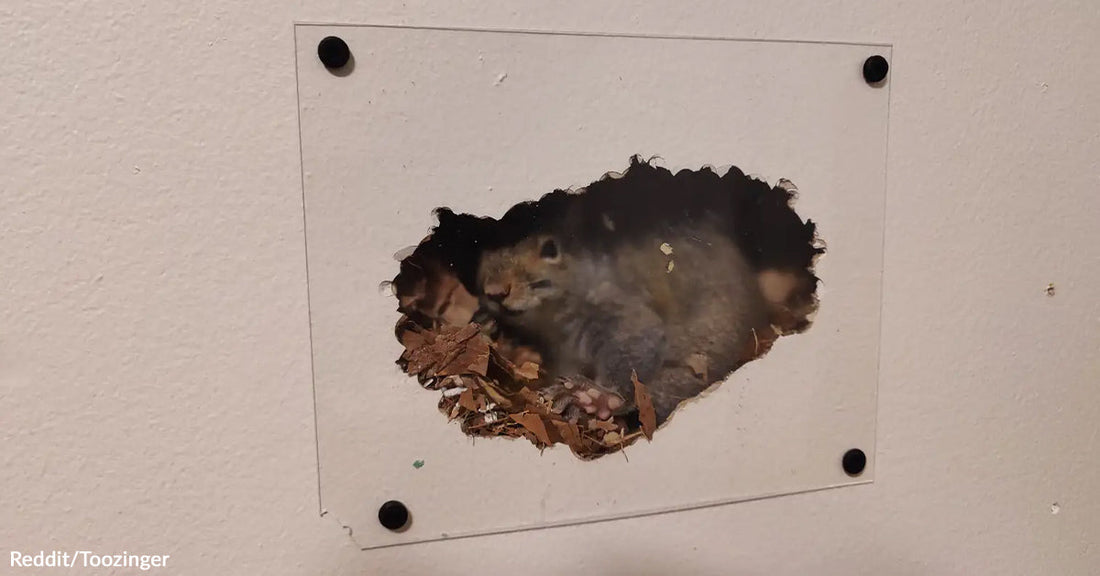
When Reddit user Toozinger began hearing scratching sounds behind the wall of his third-story apartment last December, he assumed the noise was coming from a neighbor’s cat. But as the sounds persisted and even intensified, the situation quickly took an unexpected turn. What began as a curious mystery soon revealed itself to be the work of a determined squirrel who had made herself at home inside the apartment wall. The squirrel, later named Chestnut, would become an uninvited but oddly endearing housemate, prompting Toozinger to install a small plexiglass window to observe her secret life.

This unusual tale of a squirrel in the wall is both amusing and a little surreal, and it highlights the unpredictable ways humans and wildlife sometimes cross paths. The story offers a glimpse into urban wildlife behavior, animal resilience, and one person’s creative response to an unconventional situation. It also raises questions about humane wildlife management and the challenges of sharing space with nature in densely populated areas.
Toozinger initially thought the scratching sounds were nothing more than typical apartment noise. That changed when a small hole suddenly appeared in the wall during a particularly intense scratching session. Through the hole, he caught a glimpse of the intruder: a squirrel actively burrowing inside the wall of his home. Understandably unsettled by the thought of a wild animal potentially breaking into his living space, he placed a board over the hole and notified his apartment management.
Management’s response, however, was far from ideal. According to Toozinger, they entered his apartment while he was away and placed poison inside the wall cavity, then sealed the hole with fiberboard. This approach, while intended to resolve the issue, raised legal and ethical concerns. Toozinger noted that poisoning squirrels is likely illegal and often ineffective. Indeed, the scratching soon gave way to faint whimpering, suggesting the squirrel had survived but was suffering.
Remarkably, within a week the squirrel—now affectionately called Chestnut—appeared to recover. With her health seemingly restored, she resumed her routine of entering and exiting the wall through an exterior access point. Toozinger, still concerned and curious, decided to replace the opaque board with a clear plexiglass window. This allowed him not only to monitor Chestnut’s activity but also to provide visual proof to the wildlife specialist assigned to block the squirrel’s access.
The window revealed a surprisingly well-constructed nest. Chestnut had created a cozy space for herself inside the wall, undeterred by human presence or intervention. “Chestnut had done excellent work,” Toozinger observed. “I have seen Chestnut leave the hole in the wall to run free, before coming back in some time later for a warm rest.”
What makes this story particularly compelling is Chestnut’s apparent indifference to being observed. Despite the transparent window and the occasional human attention, she continued her daily routine as if nothing had changed. “Chestnut is unbothered,” Toozinger said. “Chestnut does what Chestnut likes, regardless of human attention.”
While the novelty of having a squirrel in the wall might seem charming, Toozinger was quick to acknowledge that the situation was far from ideal. He expressed concern for both his own safety and that of the animal, particularly given the risks associated with electrical wiring and confined spaces. “I think it would be best for Chestnut to find a new living arrangement,” he said. “For both our health and safety, I hope Chestnut can be humanely removed by the wildlife specialists and the outside entrance sealed.”
Until that resolution is achieved, Chestnut continues to live her life inside the wall, occasionally venturing out and returning to her makeshift home. The experience has left a lasting impression on Toozinger, who now views squirrels with a new sense of appreciation. “I have definitely appreciated the cute and cuddly ways of Chestnut and other squirrels,” he said. “I know in the end this is an animal that would be best wild and outside.”
I found this detail striking: the installation of a plexiglass window not only served a practical purpose but also symbolized a shift in perspective—from annoyance and concern to curiosity and reluctant admiration. It’s a reminder that even in urban settings, wildlife can adapt in unexpected ways, and sometimes the best response is one that balances empathy with responsible action.
This heartwarming yet thought-provoking story of a squirrel living in the wall illustrates the complexities of coexisting with urban wildlife. It also highlights the importance of humane solutions and the role of observation in understanding animal behavior. As cities continue to grow and natural habitats shrink, encounters like this may become more common. The hope is that they will be met with the same mix of caution, creativity, and compassion that Toozinger displayed.