
Horses Use Symbols to Communicate Their Blanket Preference
Andrea Powell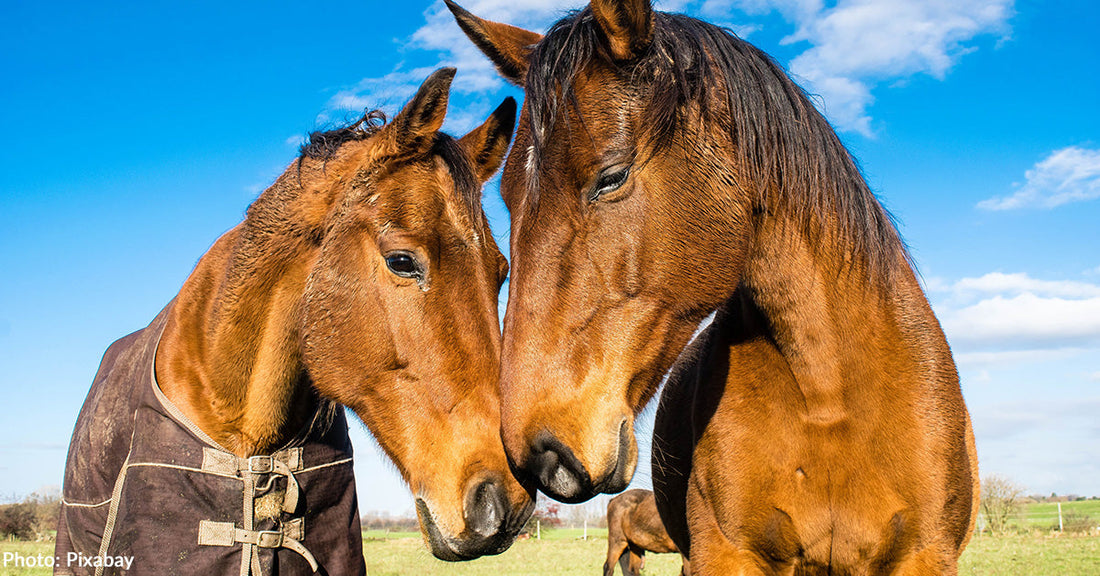
Horses are intelligent, sensitive, and perceptive animals. They have their own language that they use to communicate, one that humans are still trying to figure out.
Body language, posture, and facial expressions combined with vocalizations are how horses primarily communicate. While horse owners know that pinned ears and a swishing tail means something is amiss, there are still so many things we have yet to learn.
Horses can learn to do tricks, and complex moves through various training techniques. There are a lot of opinions on what is best for horses and one of the biggest questions people ask and debate is whether to blanket your horse in cold, winter months.

Photo: Pixabay
Horse owners have based this decision on what other horsemen have done, age and health of the horse, and climate. However, there may be another way.
What if the horse got to choose?
Researchers at Norwegian University of Life Sciences revealed that horses were able to use symbols to communicate their desire of having a blanket on or off. It was a process that involved training 23 horses (a mix of both warm-blooded and cold-blooded breeds) three different symbols, vertical bar meant "take blanket off", horizontal bar meant "put blanket on", or blank board meant "no change".
The horses were first taught to touch a board through positive reinforcement where they were rewarded with a sound (could us clicker instead) and a slice of carrot. Once this was proficient one symbol was introduced at a time. When the horse touched the symbol with their nose they would once again hear the sound, carrot, and this time the action (depending on the symbol) would be performed.

Photo: Pixabay
Horses were tested starting with blankets on and without. In just 14 days, all 23 horses were able to use the symbols to display their preference, "meaning that all horses were able to distinguish the three symbols and that they understood the consequence of touching a specific symbol on their blanket status," shared researchers.
It may come as no surprise that the horses preferred blankets on cold, wet, and windy days and wanted them off on sunny days. "When 22 horses were tested on either of two sunny days with a relatively high ambient temperature (20–23◦C), all the 10 horses wearing a blanket that day (following owners’ routine management) signalled that they wanted it taken off, and all the 12 horses not wearing a blanket signalled that they wanted to stay unchanged, i.e. continue to be without a blanket."
Just like with people, preferences change between horses. While many horses asked for a blanket when temperatures started to drop, two waited until more extreme weather to ask for a blanket.

Photo: Pixabay
Read the full methodology here if you want to learn how to teach your horse to share their opinion. So fascinating, what will researchers discover next?!